You Signed 15 New Clients Last Year and Revenue Barely Moved. Here's Why.
A founder told me something last year that stopped me mid-conversation. His agency had signed 15 new clients in 12 months. He was proud of the pace. His team was closing deals, the pipeline was active, and the win rate was healthy. By every new-business metric, the agency was performing.
Revenue grew 4%.
He'd been so focused on the front of the funnel that he hadn't noticed what was happening behind it. Of the 22 clients the agency started the year with, 8 didn't renew. Of the 14 that stayed, most were on the same scope and budget as the year before. The agency was pouring new clients into the top of the bucket and losing almost as many out the bottom. The 15 new logos weren't fueling growth. They were subsidizing churn.
When I asked how much time and budget the agency spent on new business versus growing existing accounts, the answer was roughly 85/15. Eighty-five percent of sales energy went toward strangers. Fifteen percent went toward the clients who already trusted them, already had budget, and already knew the quality of the work.
He wasn't running a growth strategy. He was running a replacement strategy and calling it growth.
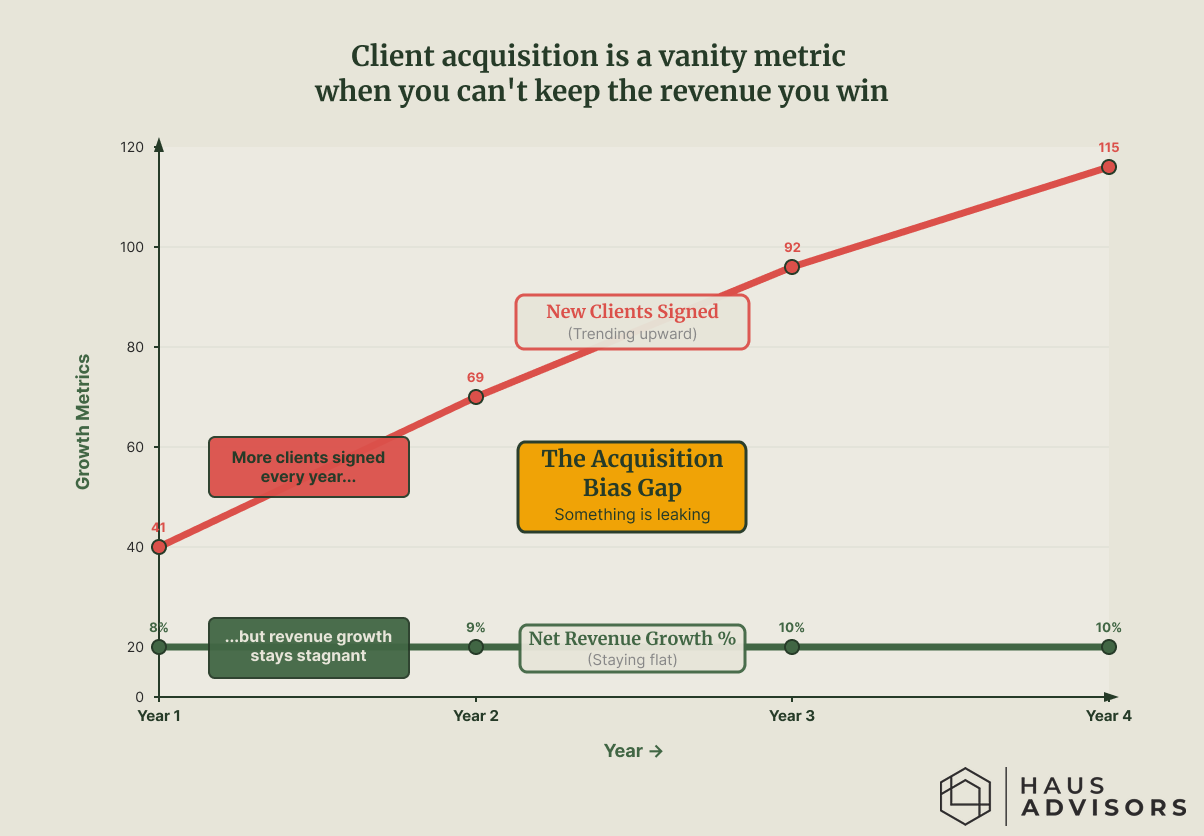
New clients signed keeps climbing. Net revenue growth stays flat. The gap between the two lines is the cost of Acquisition Bias: every new logo is subsidizing a client you didn't retain or didn't expand.
The Pattern Has a Name
I call it Acquisition Bias: the structural tendency to over-invest in winning new clients while under-investing in expanding current ones, even though expansion revenue is cheaper to generate, faster to close, and more predictable to forecast.
Here's how it develops. Most agencies start with a founder who is good at selling. The early years are defined by hustle: finding prospects, pitching, closing, delivering, then finding the next prospect. The entire muscle memory of the business is oriented toward acquisition. Every system, every meeting cadence, every compensation structure rewards bringing in new logos.
As the agency grows, this orientation calcifies. The sales team (or the founder acting as the sales team) is measured on new business. The account managers are measured on delivery satisfaction, not revenue expansion. Nobody owns the question: "How do we grow the clients we already have?"
The result is a business that works extremely hard to win clients and then does almost nothing deliberate to expand them. Expansion happens accidentally when a client asks for more work. It never happens systematically because no one built the system.
This is the core mechanism of Acquisition Bias: the agency's growth infrastructure is pointed entirely at strangers while the highest-value revenue opportunity sits inside the existing client base, unstructured and unmanaged.
The Math That Should Change Your Mind
The economics of expansion versus acquisition aren't close. They're not even in the same category.
Expansion revenue closes faster. A new client requires discovery, qualification, proposal development, negotiation, and trust-building. That cycle runs 3 to 6 months for most agency deals above $50K. An expansion conversation with an existing client who already trusts your work, already has budget context, and already understands your process can close in 2 to 4 weeks. Sometimes faster.
Expansion revenue costs less to generate. The fully loaded cost of acquiring a new agency client (sales time, marketing spend, proposal development, free strategy work during the pitch) typically runs 15 to 25 percent of the first-year contract value. The cost of expanding an existing client is a conversation. Maybe a short proposal. The trust already exists. The proof of capability already exists. The relationship infrastructure is already built.
Expansion revenue is more predictable. You can't forecast when a stranger will sign. You can forecast when an existing client's current project will end and what their next set of problems looks like, because you're already inside the account. Expansion revenue turns your pipeline from a series of independent bets into a compounding portfolio.
Expansion clients stay longer. Clients who expand their relationship with an agency are significantly less likely to churn than clients on a single engagement. Every additional project adds switching cost, institutional context, and relationship depth. The client who has worked with you on three projects has built a dependency that a single-project client never develops.
None of this is counterintuitive. Most founders nod along when they hear it. And then they go back to spending 85 percent of their sales energy on new logos, because that's the muscle the business trained.
Why the Bias Persists
Acquisition Bias survives because it's emotionally satisfying in ways that expansion work isn't.
New logos feel like progress. Signing a new client is an event. There's a proposal, a negotiation, a close. The team celebrates. It shows up on a dashboard. It feels like the business is growing. Expanding an existing client from $80K to $140K is a quiet conversation that nobody high-fives over, even though the $60K of incremental revenue was cheaper and faster to earn than any new deal in the pipeline.
New business has a clear owner. The founder, the sales lead, the BD team. Someone wakes up every morning thinking about new logos. Expansion rarely has an owner. Account managers are focused on delivery. The founder is focused on acquisition. The space between "keeping the client happy" and "growing the client's spend" belongs to nobody.
The agency's identity is built around winning. Agency culture celebrates the hunt. The pitch. The close. Founders tell origin stories about landing their first big client, not about growing their fifth client from a $30K project to a $200K annual relationship. The narrative infrastructure of the business makes acquisition feel heroic and expansion feel administrative.
Expansion requires a different skill. Winning a new client is a sales skill. Expanding an existing client is a diagnostic skill. It requires seeing problems the client hasn't articulated, connecting your capabilities to their evolving needs, and presenting opportunities that feel like natural next steps rather than upsells. Many agencies have the first skill and not the second, because they never practiced the second.
What Expansion Actually Looks Like
Agencies that are good at expansion don't upsell. They don't pitch add-ons or bundle services hoping the client will bite. They do something structurally different: they build a diagnostic relationship that naturally surfaces the next engagement.
They map the client's problem set, not just the current project. During every engagement, they develop a view of the client's broader challenges. The current project addresses one of those challenges. The others become future conversations. This isn't speculative. It's observational. When you're inside a client's systems, strategy, or operations, you see things the client hasn't prioritized yet. The agencies that expand well are the ones that document what they see and bring it back to the client at the right moment.
They create a defined expansion path. Instead of waiting for the client to ask "what else can you do?", they build a sequence of offerings that naturally follow the initial engagement. A technical audit leads to a roadmap. A roadmap leads to an implementation phase. An implementation leads to an optimization retainer. Each step is a defined product with a clear scope, not a custom proposal that has to be invented from scratch. This is Productization applied to the existing client base.
They separate the expansion conversation from the delivery relationship. The person managing the project shouldn't also be responsible for growing the account. Those are different conversations with different dynamics. The project manager's job is to keep the client happy with the current work. The expansion conversation is about the client's future needs. When the same person handles both, the expansion conversation never happens because the delivery conversation is always more urgent.
They time expansion to the diagnostic window. The best moment to present an expansion opportunity is when you've just demonstrated competence on the current project. Not at the end, when the client is mentally closing the chapter. During the engagement, when the client is seeing the quality of the work in real time and trust is at its highest. The agencies that wait until the project is done to talk about what's next have already missed the window.
The Connection to The Delivery Trap
If you read The Delivery Trap, this is the natural sequel. The Delivery Trap explains why clients leave even when the work is excellent: the relationship was designed to end. Acquisition Bias explains why agencies don't notice: they're too busy replacing lost clients with new ones to realize the replacement was avoidable.
These two patterns compound. An agency that doesn't build retention architecture (Delivery Trap) and also doesn't build expansion systems (Acquisition Bias) is running on a treadmill. It works harder every year to maintain the same revenue, because it's simultaneously losing clients it should have kept and under-monetizing the clients that stayed.
Fix one without the other and you get partial results. Fix both and the economics of the business change fundamentally. Revenue becomes more predictable, acquisition pressure drops, and the founder can shift from "how do we find more clients?" to "how do we deepen the clients we have?"
The Objection Worth Addressing
"We don't want to be pushy with our existing clients. If they need more work, they'll ask."
This is the strongest version of the objection, and it deserves a direct answer.
Clients don't ask for more work because they don't know what to ask for. They hired you to solve a specific problem. They're not sitting around thinking about what else you could do for them. That's your job. Not because you're being pushy, but because you have context they don't have. You've been inside their systems. You've seen their technical debt, their process gaps, their strategic blind spots. You know things about their business that they haven't surfaced yet.
Presenting those observations isn't sales. It's the diagnostic obligation that comes with the access they gave you. A doctor who notices a concerning symptom during a routine checkup and doesn't mention it isn't being "non-pushy." They're being negligent. The same principle applies. If you see a problem and you have the expertise to address it, raising it is part of the value you provide.
The agencies that frame expansion as "upselling" feel uncomfortable because they're thinking about their own revenue. The agencies that frame expansion as "ongoing diagnosis" feel comfortable because they're thinking about the client's outcomes. The framing determines the experience for both sides.
What Acquisition Bias Actually Costs You
Flat revenue despite strong new business. This is the most visible symptom. The agency signs 10, 15, 20 new clients a year and revenue grows in single digits because churn and flat accounts eat the gains. The founder can't understand why the sales effort isn't translating into growth.
Permanent founder dependency on sales. When the only growth engine is new business, the founder can never step back from sales. Expansion revenue is the path to reducing founder sales dependency, because it doesn't require the founder's personal relationships or pitch skills. It requires a system that anyone on the account team can run.
A shallow client portfolio. Twenty clients at $50K each is a fragile business. Ten clients at $100K each is a stronger business. Five clients at $200K each with a clear expansion trajectory is a durable business. Acquisition Bias keeps agencies in the first category permanently, because it never develops the discipline of deepening relationships.
Wasted positioning advantage. An agency that specializes builds compounding domain expertise with every engagement. But if that expertise never translates into expanded relationships, the compounding stops at the surface. The deep knowledge that should make expansion natural gets wasted because no one built the system to use it.
The Audit
Pull your client list from the last 12 months. For each active client, answer two questions:
What percentage of this client's addressable budget does your agency currently capture? If you're doing $80K of work for a client who spends $400K on services you could provide, you're capturing 20 percent. That's not a satisfied client. That's an untapped client.
Is there a defined next engagement for this client, or are you waiting for them to ask? If you're waiting, Acquisition Bias is active.
Then calculate one number: what percentage of last year's revenue came from expanding existing clients versus signing new ones? If expansion revenue is below 30 percent of total growth, the bias is structural. You don't have a new business problem. You have an expansion problem disguised as a new business problem.
The principle is this:
The most expensive client to win is a stranger. The cheapest client to grow is someone who already trusts you. Every dollar of sales energy you redirect from acquisition to expansion returns more revenue, more predictably, at lower cost. The agencies that figure this out stop running on the treadmill and start compounding.
Most founders reading this already know the real problem. It isn't more pipeline. It's that the reputation, the relationships, and the judgment that make your agency worth hiring still live in your head. So the business only grows when you're in the room.
That's the work we do at Haus Advisors. The Relevance Engineering Program is six months of implementation, not a strategy document. We pull what makes your agency relevant out of your head, build it into positioning, offers, and growth plays your team can run, and hand ownership to them. If you want an agency that grows without needing you in every deal, book a call to see if it's a fit.
Keep reading
Browse by topic
- Positioning & Strategy
- Lead Gen & Marketing
- Sales & Biz Dev
- Pricing & Productization
- Research & Data
- Operations & Delivery
- Client Retention & Expansion
- Leadership & Culture
For founders whose agency has outgrown referrals.
One idea a week that makes a hard growth problem obvious, usually with a chart that shows you the mechanism behind it.
Built from conversations with seventy-plus agency founders on the Behind the Agency podcast.