Every Custom Proposal You Write Is a Vote Against Your Own Scalability
I watched a founder spend eleven hours last month writing a single proposal. It was thorough. Detailed architecture plan, phased timeline, risk assessment, team allocation, and a custom pricing model built around the prospect's specific requirements. He sent it at midnight, slept three hours, and then did it again two days later for a different prospect with a completely different scope.
He'd written forty-seven proposals like this in the past year. Each one unique. Each one consuming eight to twelve hours of his time. Each one starting from a blank page because nothing about the previous proposal was reusable.
That's roughly five hundred hours of the founder's year spent on proposals. More than a quarter of his total working time. And because every proposal was custom, every delivery engagement was also custom, which meant every project required his direct involvement in scoping, oversight, and client communication. He couldn't delegate sales because nobody else could custom-scope. He couldn't delegate delivery because nothing was standardized enough for a team to run independently.
He didn't have a sales problem. He had a service architecture problem. And he was compounding it with every custom proposal he wrote.
The Pattern Has a Name
I call it The Custom Scope Spiral: the self-reinforcing cycle in which custom proposals produce custom engagements, which consume the founder's time, which prevents the creation of standardized offerings, which forces the next prospect into another custom proposal. Each iteration tightens the spiral and deepens the founder's dependency.
Here's the mechanism. When your agency doesn't have defined, productized service offerings, every inbound prospect is a blank canvas. The founder has to assess the prospect's needs, design a custom solution, estimate hours, price the engagement, and package all of it into a document that communicates enough value to justify the cost. This process is slow, non-repeatable, and entirely dependent on the founder's judgment.
Once the proposal is accepted, the custom scope creates a custom delivery engagement. The team can't follow a standard process because there isn't one. The founder stays involved in every decision because only the founder understands the full scope. Quality depends on the founder's attention. The founder's calendar fills with delivery oversight, which means even less time to think about standardization. And when the next prospect arrives, the cycle starts again from zero.
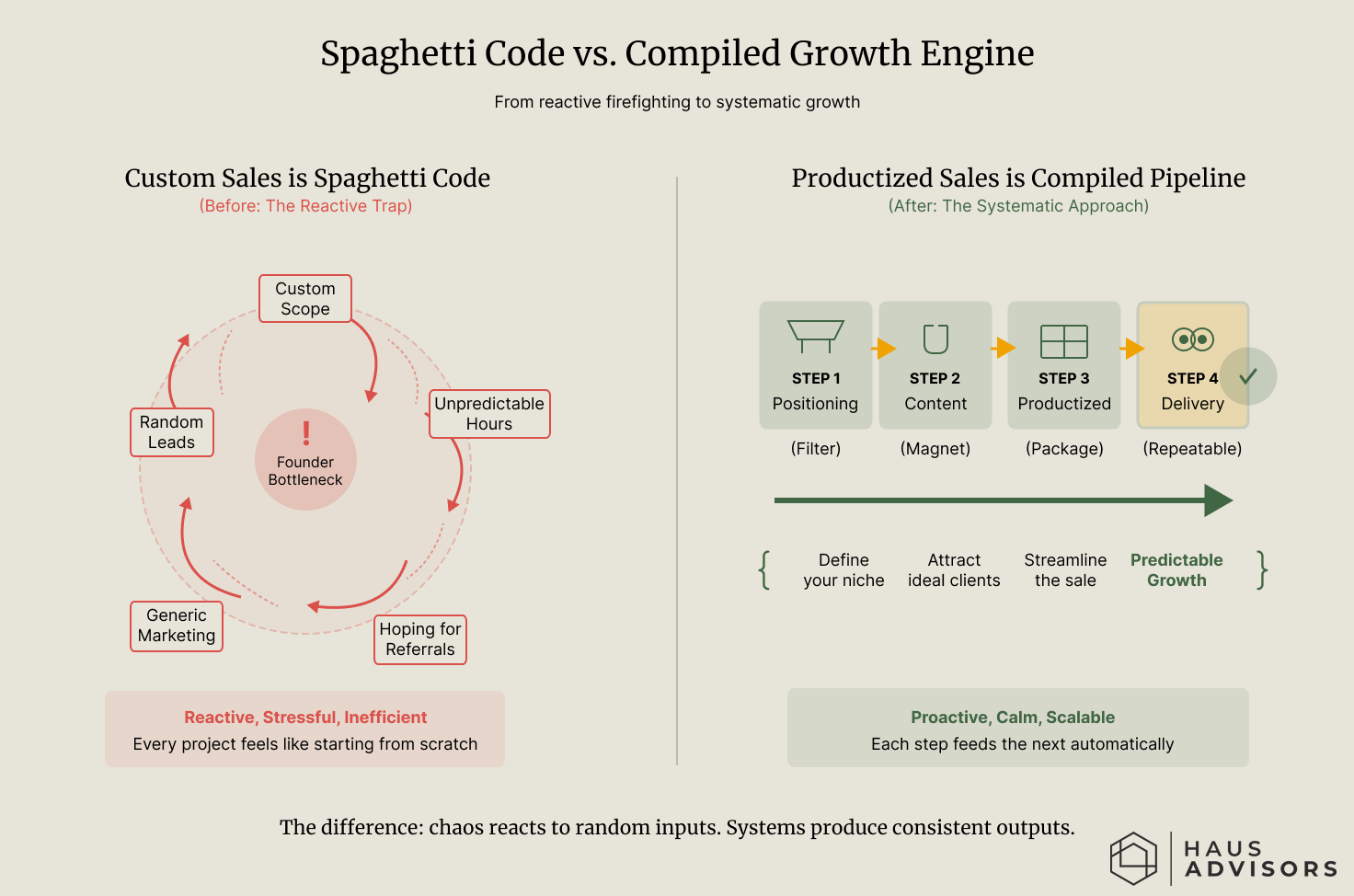
The architecture problem: Custom sales is spaghetti code: every path through the system is unique, nothing is reusable, and only the original author understands how it works. Productized sales is a compiled pipeline: defined inputs, predictable processing, consistent outputs. The refactor isn't about selling less. It's about selling the same core solution repeatedly, with implementation details that vary within defined parameters.
The Custom Scope Spiral is the operational equivalent of technical debt. Each custom engagement feels productive in the moment because it generates revenue. But it also adds complexity to the system: a unique client expectation, a one-off delivery process, a scope that can't be templated. Over time, the accumulated complexity makes the business harder to run, harder to scale, and more dependent on the one person who holds all the context. The revenue goes up. The operational burden goes up faster.
Why You Keep Writing Custom Proposals
Because custom scoping feels like a competitive advantage. The ability to assess any prospect's needs and design a tailored solution is a genuine skill. It signals expertise. It demonstrates flexibility. It shows the client that you're taking their situation seriously rather than forcing them into a pre-built box.
In the early days, this was correct. At Stage 1 (validation), custom scoping is how you learn what you're good at. You say yes to diverse projects because you need revenue and information. Each custom engagement teaches you something about your capabilities, your market, and the types of problems you solve best. The custom approach is a feature, not a bug.
The problem is that most agencies never transition out of this mode. The custom approach that generated early learning becomes the default operating model. At $1M, $2M, $3M, the agency is still scoping every deal from scratch, still requiring the founder for every proposal, still delivering every project as if it's the first time they've encountered the problem.
This is the engineering equivalent of never refactoring your prototype into production code. The prototype worked. It proved the concept. But running a business on prototype-quality operations means every process is fragile, every dependency is on the founder, and every new feature (client) introduces unpredictable complexity.
The transition from custom to productized isn't about limiting what you offer. It's about recognizing that your best engagements follow patterns, and those patterns can be standardized into offerings that your team can scope, sell, and deliver without the founder in the room.
What the Custom Scope Spiral Actually Costs You
The founder as single point of failure. When every engagement is custom, only the founder has the full context to scope, price, and oversee delivery. This creates a hard ceiling on revenue: the agency can only handle as many projects as the founder can personally manage. It also creates fragility: if the founder is sick, traveling, or simply burned out, the entire sales and delivery pipeline stalls.
Margins that shrink as revenue grows. Custom scoping is inherently inefficient. Each proposal consumes founder time that could be spent on higher-leverage activities. Each delivery engagement requires custom project management that can't be templated. The cost of sale and the cost of delivery both scale linearly with revenue, which means margins stay flat or compress as the agency grows. You're adding revenue but not building leverage.
Inability to delegate sales or delivery. A productized offering can be sold by someone other than the founder because the scope, pricing, and deliverables are defined. A custom scope can't, because the value proposition changes with every prospect. Similarly, a productized delivery process can be executed by a trained team. A custom delivery engagement requires senior judgment at every turn. The Custom Scope Spiral locks both sales and delivery to the founder's personal bandwidth.
Marketing that can't be specific. When you sell "whatever the client needs," your content and messaging have to cover every possible use case. This produces generic marketing: "We build custom software solutions." You can't create case studies that speak to a specific buyer's problem because your work is spread across dozens of unrelated problems. Your content has to be broad enough to encompass everything, which means it resonates with nobody in particular.
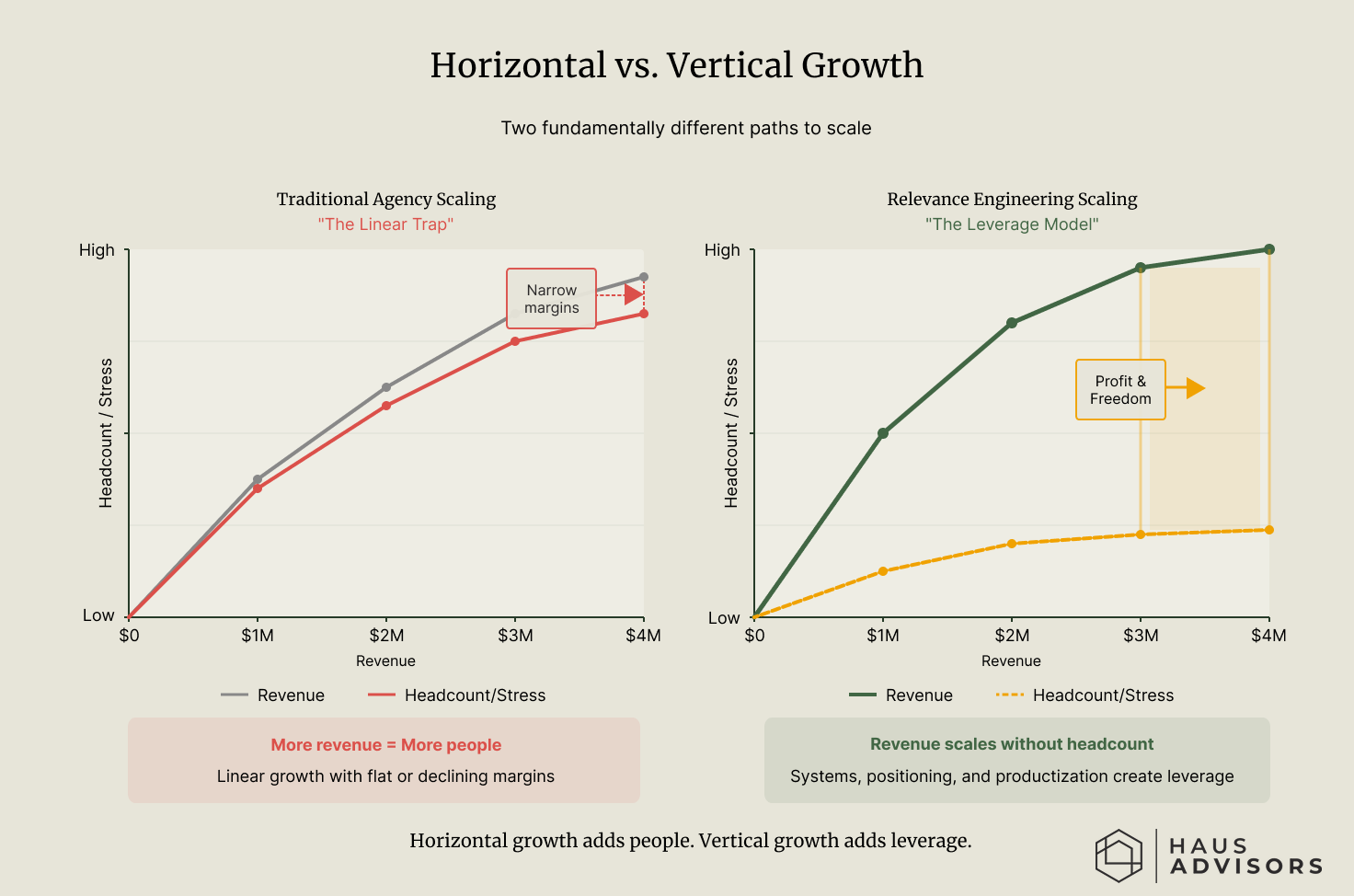
Two scaling architectures: Horizontal scaling adds headcount to handle more custom work. Revenue grows, but margins stay flat and complexity compounds. Vertical scaling uses productized offerings to increase revenue per employee. Headcount grows slower. Margins expand. The founder's time shifts from delivery to strategy. The Custom Scope Spiral traps agencies in horizontal scaling. Productization enables vertical scaling.
Custom vs. Productized
This is the part most people miss.
Agencies treat "custom" and "productized" as a binary: either you tailor everything to the client, or you force them into a rigid package. This framing makes productization feel like a downgrade. Less responsive. Less flexible. Less "agency."
In reality, the best productized offerings aren't rigid. They're standardized at the architecture level and flexible at the implementation level. Think of it the way you'd think about a well-designed software framework: the core logic is defined, reusable, and tested. The configuration varies by deployment. The client gets a solution that feels tailored to their situation because the implementation details are adapted to their context. But underneath, the delivery team is following a proven process that they've executed dozens of times.
A Technical Architecture Audit, for example, has a defined scope (evaluate current architecture against scalability requirements), a defined deliverable (prioritized recommendations with implementation roadmap), and a defined timeline (two to three weeks). The findings vary by client. The process doesn't. That means a senior team member can run it without the founder in the room. The proposal takes thirty minutes to prepare, not twelve hours. And the delivery quality is higher than custom work, because the team has refined the process through repetition.
The transformation sounds like this:
Custom: "We'll analyze your needs and create a custom quote. Let me look at your codebase and I'll get back to you in a week."
Productized: "Here's our Architecture Audit Sprint. Three weeks. Defined deliverables. Here's exactly what you get and what it costs. Two of our engineers ran this exact process for a company at your stage last month."
The second version closes faster, delivers more predictably, and doesn't require the founder. That's the refactor.
Building the Productized Offering From Your Own History
The founders who resist productization often believe it requires inventing something new. It doesn't. The best productized offerings are already hiding in your past engagements.
Identify your most repeated pattern. Look at the last two years of projects. Which type of engagement have you done at least five times? Not the exact same scope, but the same general category: onboarding optimization, API migration, performance audit, MVP build. That repetition is the signal that a productized offering exists inside your custom work.
Extract the consistent scope. Across those five-plus engagements, what was always in scope? What deliverables were always produced? What timeline was typical? Those consistencies become the defined parameters of the productized offering. The variation between engagements becomes the "configuration" layer that makes each deployment feel tailored.
Price for value, not hours. Custom work is priced by estimating hours because there's no other anchor. Productized work can be priced by the value of the deliverable, because the deliverable is defined and the client can evaluate what they're getting. An Architecture Audit that produces a prioritized roadmap with implementation estimates is worth a defined amount to the buyer. Whether it takes your team 40 hours or 60 hours is an operational detail, not a pricing input.
Name it. This sounds trivial. It's not. A named offering ("The SaaS Scalability Audit," "The Conversion Diagnostic Sprint," "The MVP Architecture Review") is transmittable in a way that "custom development services" isn't. Your clients can refer it by name. Your team can sell it by name. Your website can feature it by name. The name turns an abstract capability into a concrete product that the market can evaluate.
The Honest Objection
Here's the strongest argument against productization: clients have unique problems. A standardized offering can't address the specific complexity of each client's situation. By packaging your work, you're sacrificing the nuanced, tailored approach that high-end clients expect and pay a premium for.
This concern is especially common among technical founders, who have a deep appreciation for the complexity beneath every client's surface. They've seen "productized" agencies deliver cookie-cutter work that misses critical requirements. They don't want to be that.
Where That Logic Hits a Wall
But the concern conflates two different things: standardized process and standardized output. Productization standardizes the process (how you diagnose, analyze, and deliver) while allowing the output to vary by client. The engagement follows a defined methodology. The recommendations are specific to the client's situation.
This is exactly how the best consulting firms operate. McKinsey doesn't custom-scope every engagement from scratch. They have defined frameworks, standard deliverable formats, and repeatable methodologies. The insights vary by client. The process doesn't. And nobody accuses McKinsey of delivering cookie-cutter work.
The agencies I've watched make this transition successfully didn't sacrifice quality. They improved it, because the delivery team was following a refined process rather than inventing a new one every time. The founder's expertise was embedded in the methodology rather than required in the room. And the margins expanded because the cost of delivery dropped while the value of the deliverable stayed constant.
The Next Step
You don't need to productize your entire service offering this quarter. You need to test whether the Custom Scope Spiral is active in your operations.
Start here: pull up the last five proposals you sent. Measure two things. First, how many hours did each proposal take to prepare? Second, how much of each proposal was reusable from a previous one?
If each proposal took more than two hours and less than 30% of the content was reused, the spiral is active. You're writing new code for every client when you could be deploying a tested build.
The refactor starts with one offering. Your most repeated engagement type, standardized into a defined scope, timeline, deliverable, and price. One offering that your team can sell and deliver without you in the room. That's the first commit toward an agency that scales with leverage rather than with the founder's hours.
The principle is simple:
There are agencies that sell custom solutions to every client, and there are agencies that sell a proven methodology adapted to each client.
The first group works harder with every new deal. The second group builds leverage with every new deal.
At Haus Advisors, we help dev shops and technical agencies refactor from custom scoping to productized growth: defined offerings, repeatable sales processes, and delivery systems that run without the founder. Our Why Us Sprint identifies the productized offering hiding in your past work and packages it into something your team can sell and deliver independently. If every proposal still starts from a blank page, that's exactly the refactor we build. Book a strategy call here →