Your Agency Isn't Growing Because You're Doing Too Much
A founder I talked to last spring had built his development agency to $3.2 million. Fourteen people. React builds for healthcare startups, Shopify work for fashion brands, custom API work for a couple of fintech clients. The team could build anything.
He was also running a podcast. A monthly newsletter. A cold email campaign. A LinkedIn posting schedule. Two new service lines he'd added in the last year because a client asked.
And the revenue line had been flat for eighteen months.
He wasn't lazy. He was doing more than he'd ever done. That was the problem, though he couldn't see it yet.
So I asked him one question. Of everything on that list, which one brought you a client in the last twelve months. He went quiet. Then he said the podcast probably helped with credibility. I asked how many downloads the last episode got. Forty.
That's the moment I want to talk about. Because if you're asking why your agency isn't growing, you've probably been handed the same answer everywhere you looked. Do more. Bill more. Add a channel. Hire ahead. Raise your rates.
More effort is not your problem. You're already past the edge of what you can sustain. And the value in that agency is real. Fourteen people who can build anything. A founder who knows exactly which clients were worth having and which work they win. What's missing is a way for the company to use that judgment without him making every call. So everything stays, because he's the only filter, and he's out of hours.
The business you want isn't missing. It's buried.
When someone asked Michelangelo how he carved the David, he said he just removed everything that wasn't David. The statue was already in the stone. His whole job was taking away. That's the truest thing I know about agencies that stall at $2M or $3M and can't figure out why. The agency you're trying to build is already in there. It's sitting under everything you're doing that isn't it. The work isn't adding. The work is subtraction.
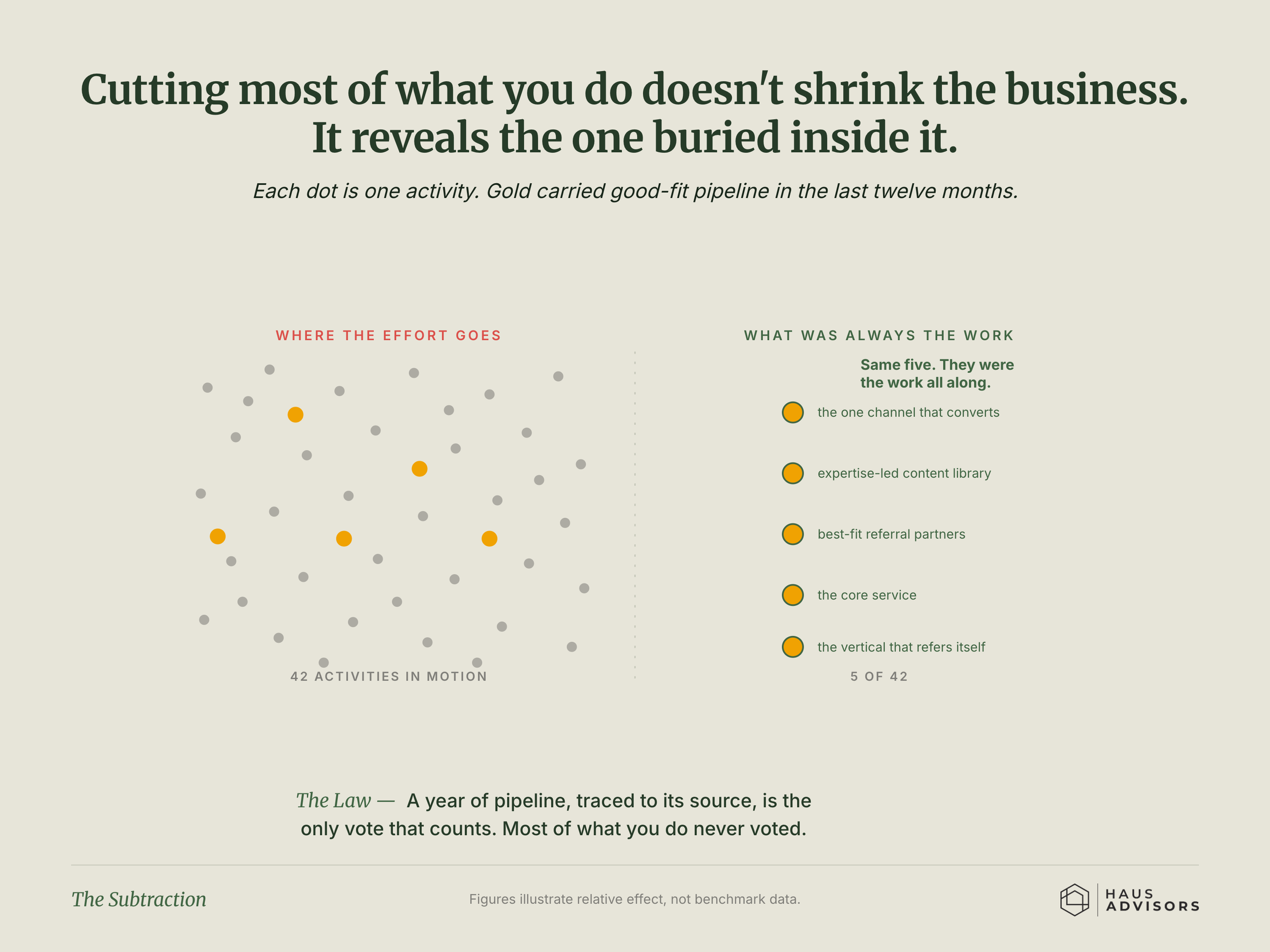
Most agencies run 40-plus activities. Five drive the pipeline. The rest is motion. Cutting it doesn't shrink the business, it reveals the one that was always inside it.
Your Agency Isn't Stalled Because You're Doing Too Little
Nearly every article on this question hands you a checklist. One of the most-read ones opens by telling you agency growth requires at least eight things, then gives you a menu: raise your billable ratio, raise your rates, upsell your clients, chase new ones, add capacity, build cash reserves, get lucky.
None of that is wrong, exactly. It's just the wrong medicine for what you have.
Think about who's actually reading this. You're not a founder sitting on idle capacity, hunting for one more lever to pull. You're maxed out. You're working more hours at $3M than you did at $1M. If "do more" were the answer, you'd have grown already, because more is the one thing you've been doing without stopping.
Here's the part the checklists skip. Your effort is scattered, not insufficient. A small number of activities bring in almost all of your good-fit pipeline. The rest is motion. It fills your calendar and drains your week. And it produces close to nothing you can trace back to revenue.
Most founders can't see this because they've never counted. They feel busy, and busy feels like progress. So the podcast stays. The second service line stays. The fourth vertical stays. Everything stays, because cutting feels like going backward and adding feels like control.
I'll say it plainly. You don't have a growth problem. You have a subtraction problem. The whole genre of advice on this question points you one direction when the answer is the other.
What the SERP tells you
The subtraction move
What the SERP tells youThe subtraction realityRaise your rates across all servicesKill the two services that drag down your marginBuild new outbound channelsDouble down on the one channel that actually converted last yearHire delivery ops to scale capacityNarrow your scope so delivery gets simpleUpsell your existing bad-fit clientsFire bad-fit revenue to clear room for right-fit pipeline
One column adds. The other takes away. The whole SERP lives in the left column. Your growth is in the right one.
A fair caveat before we go further. This isn't for a $500K agency still finding its footing. At that stage, trying things is the job. Throwing spaghetti at the wall is how you learn what sticks. The subtraction argument kicks in later, once you've got real signal about what works and you're still doing everything anyway. Under your first million, keep experimenting. Stuck above it, keep reading.
Why "Do More" Feels Right (And Why It's Killing Your Margin)
There's a reason the "add a tactic" reflex is so strong. When growth stalls, doing something new feels like taking action. Stopping feels like quitting. So you add.
“Every tactic you keep carries a price that never shows up on an invoice.”
Adding also hides the real cost. Every tactic you keep carries a price that never shows up on an invoice. The podcast costs you a day a month. The extra service line costs you focus, and it costs your team the tax of switching into work they're slower at. The fourth vertical means four versions of your message, four sales conversations you're mediocre in instead of one you're great in.
Those costs land on your margin. You don't feel them as a line item. You feel them as a team that's always busy and a P&L that won't move.
Then there's the measurement gap. Most agencies can't tie pipeline back to activity. You know revenue came in. You don't know which of your fifteen efforts produced it. And when you can't measure it, you keep doing all of it, because cutting the wrong one feels too risky. So you cut nothing.
The last trap is the hardest. Sunk cost. The podcast you've published for two years. The service line you're known for. The vertical that pays the bills but grinds your team down. The more you've put into something, the more it hurts to kill it, even when it stopped working a year ago.
Add it all up and you get an agency running flat out and going nowhere. Not because the founder is doing too little. Because they've never had a way to decide what to stop.
The Root Cause: You Can't Subtract Because You Can't Say Who You're For
Here's where most advice stops and the real answer starts.
You're not failing to cut because you lack discipline. You're failing to cut because you have no basis for the decision. When every tactic looks equally worth doing, you keep all of them. And the reason every tactic looks equally worth doing is that you've never said, clearly, who you're best for.
“You can’t say no to bad-fit tactics because you haven’t said a clear yes to a specific market problem.”
Read that twice, because it's the whole thing. You can't say no to bad-fit tactics because you haven't said a clear yes to a specific market problem.
Positioning is not a marketing exercise. It's a decision filter. Its real job isn't a nicer homepage. Its job is to let you say no. When you know exactly who you serve and which problem you solve better than anyone, most of your tactics answer for themselves. The channel that reaches those buyers stays. The three that don't, go. The service that solves their real problem stays. The two you bolted on to keep one client happy, go.
Without that filter, everything is a maybe. And a business full of maybes says yes to all of them.
I see the technical-founder version of this constantly. You built the agency on referrals and delivery. You never had to choose a lane, because the work kept coming and you could do all of it well. Then the referral flow thinned. Maybe the market softened. Maybe AI started eating the low end of what you sell. And now the missing filter, which never cost you a thing before, shows up as flat growth. That's the pattern I call the Delivery Trap. Great work that stopped generating growth, because nothing in the market points to a clear thing you're the obvious choice for.
You don't fix that by adding a sixteenth tactic. You fix it by deciding who you're for, and letting that decision cut the list for you.
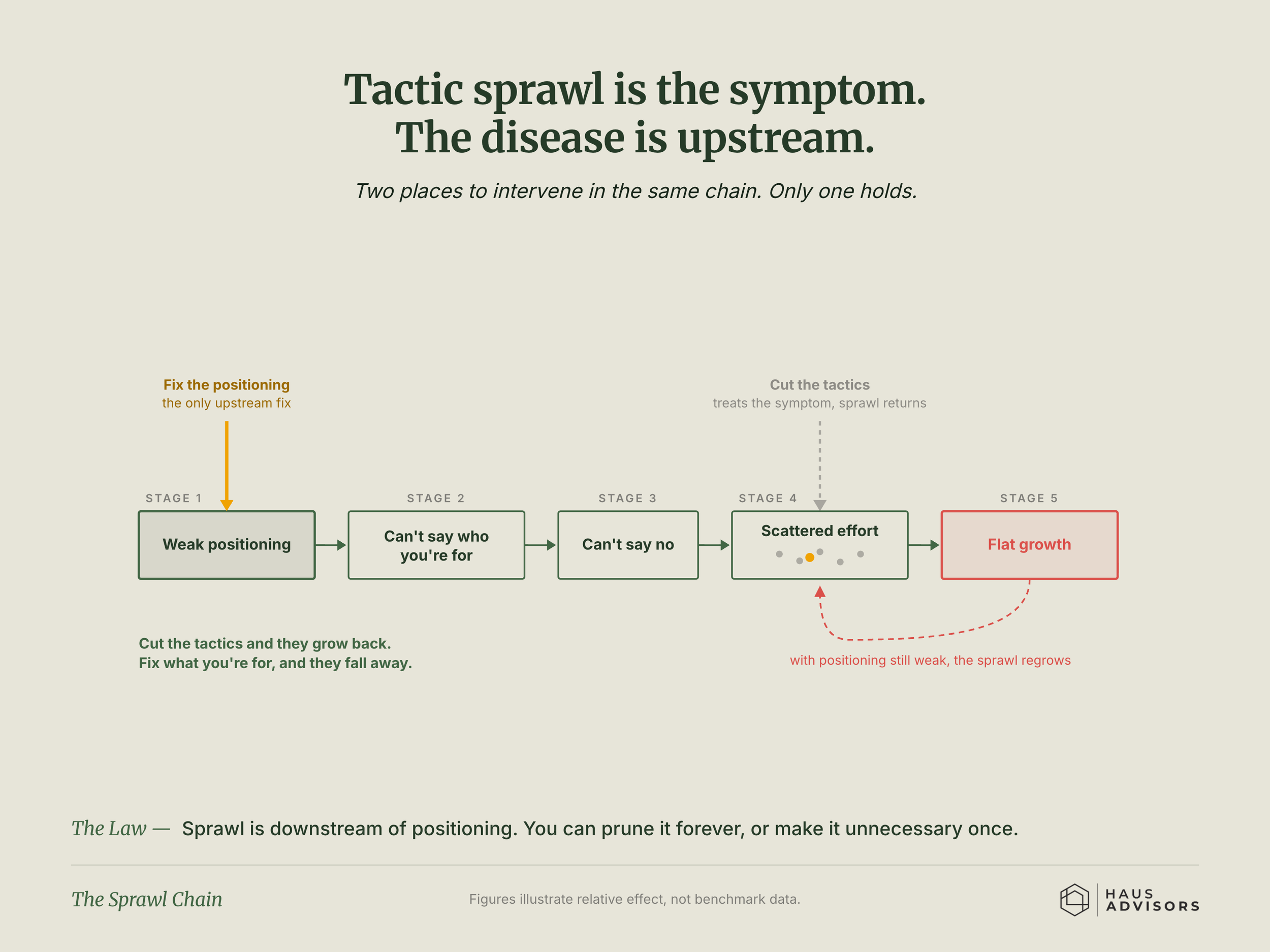
Cut the tactics and they grow back. Positioning is the only fix upstream of the sprawl.
The Art of Subtraction: How to Find Your High-Leverage Pipeline
Let's make this concrete. Subtraction isn't a mood. It's a method, and you can run it this week. I call it the twelve-month trace.
Start by mapping where the effort actually goes. Write down every activity eating real time or money. Every channel, every service line, every vertical, every content format, every outbound motion. Most founders are surprised how long the list gets once it's on paper.
Now put twelve months of pipeline next to it. For each activity, ask one question. What real, good-fit pipeline did this produce in the last year. Not impressions. Not brand. Not "it probably helps." Actual conversations with buyers you'd want. If you can't name one, write a zero.
The pattern almost always holds. A handful of activities produced nearly all of your good pipeline. A long tail produced close to nothing. I've watched founders run this and find that five things out of forty were carrying the business, and the other thirty-five were carrying the founder toward burnout.
Those five are not random. They're almost always tied to your real expertise and your best-fit clients. Which means they were downstream of positioning the whole time. The high-leverage work was always there. It was just buried under the noise you'd mistaken for a strategy.
Then comes the part that's hard, and the part that matters. You have to cut, not just rank.
Prioritizing is the lie founders tell themselves to avoid stopping. You move the weak stuff "lower on the list" and keep doing it anyway. Subtraction means removal. Kill the service line. Drop the vertical. End the channel that never converted. Not deprioritize. End.
I know how that lands. Cutting feels like shrinking. It isn't. You're not making the agency smaller. You're concentrating everything you've got on the few things that compound. Less surface area, more pipeline. The agency gets narrower and stronger at the same time. What's left when you're done isn't a lesser business. It's the one that was inside the block the whole time.
Diagnostic
Do you have a subtraction problem?
Five questions from the twelve-month trace. Answer honestly. It takes about a minute.
Nothing is stored. This runs entirely in your browser.
Free diagnostic
Find out whether your homepage names a buyer, or reads like anyone's.
The sprawl starts with weak positioning, and it shows up first on your homepage. Signal Check grades yours across five messaging signals in about thirty seconds, benchmarks it against other technical agency homepages, and hands you the single quickest fix. Free and instant.
Run Signal CheckThe Tactics Founders Cut Too Late (And the Ones They Cut by Mistake)
Run enough of these and you start seeing the same items on every kill list. I call them zombie tactics. They're not alive, but nobody's willing to bury them.
Zombie 01
The appeasement service line
A quarterly service kept breathing to keep one client happy. A sliver of your revenue, a big share of your team's headaches.
Zombie 02
The 40-listen podcast
Thought leadership none of whose listeners control a budget. It feels like marketing. It's a hobby with a logo.
Zombie 03
Four messages, four verticals
Kept alive because "we can do all of it." All four read vague, because a message built to fit everyone fits no one.
Those are the ones founders cut too late. Now the ones they cut by mistake, which matter just as much.
The slow-compounding asset that gets killed because it didn't convert this quarter. The clearest example is a real content library, the kind built around your actual expertise and aimed at your actual buyer. It won't produce a lead next Tuesday. It produces trust over eighteen months, and then it produces the best clients you've ever landed. Run the twelve-month trace too literally and you'll flag it as dead weight and cut the one thing quietly working. Don't. This is what I mean when I say your blog is not a publication. It's a library. Libraries compound.
Telling a zombie from a slow compounder comes down to one question you ask of each. Is this tied to my real expertise and my best-fit buyer, and is it building something over time. If yes, it stays, even if it's slow. If it's motion you've rationalized, it goes. The test isn't "did it work this month." The test is "is this the real work done patiently, or noise I've gotten used to."
How to Cut With Conviction (Without Cutting the Wrong Thing)
Here's the honest reason founders don't do this alone. It isn't the mapping. Anyone can list their tactics. It's the cutting. When you're inside the business, you can't always tell which activities are load-bearing and which just feel that way. Unsure, you cut nothing and keep everything, which is right where you started.
“That uncertainty is the actual constraint. Not effort. Not talent.”
That uncertainty is the actual constraint. Not effort. Not talent. The inability to know, with enough confidence to act, what to stop.
Getting an outside read on that list is the first phase of the New-Business Engine, the part we call Find it. We sit with you and pull out what you actually know: which clients were worth having, which work you're the obvious choice for, what the five load-bearing activities have in common. Most of that is in your head and nowhere else, which is the real reason you can't cut alone. You're being asked to grade your own list with a filter nobody has ever written down. Once it's on paper, the cuts stop feeling like risk.
If you're not ready for that, start smaller. is our free diagnostic. It surfaces the leading indicators of whether your effort is scattered and your positioning is pulling its weight. It's the fastest way to see whether you have a subtraction problem before you spend a dollar fixing it.
Underneath both is the reason subtraction sticks or doesn't. Cutting once is a purge. The sprawl grows back in six months if the filter still lives only in you, because every new yes still routes through your judgment, and your judgment is busy. So the rest of the Program is about moving that filter into the business. Find it is where we write it down. Fix it is where it becomes positioning that repels wrong-fit work, published expertise that pulls the right buyers toward you, and productized offers that make the buying decision simple. Hand it over is where your team learns to say no without you in the room. And compounding is what happens when they keep saying it.
Most founders reading this already know the real problem. It isn't the podcast, and it isn't the fourth vertical. It's that the reputation, the relationships, and the judgment that make your agency worth hiring still live in your head. So the business only grows when you're in the room.
That's the work we do at Haus Advisors. The New-Business Engine is six months of implementation, not a strategy document. We pull what makes your agency relevant out of your head, build it into positioning, offers, and growth plays your team can run, and hand ownership to them. If you want an agency that grows without needing you in every deal, book a call to see if it's a fit.
What to Do This Week
You don't need us to start. You need to change the question you're asking.
“Stop asking what else you can add. Start asking what you can remove so the real work is finally visible.”
Stop asking what else you can add. Start asking what you can remove so the real work is finally visible. That one swap changes what you look for, and what you look for changes what you find.
Then run the trace. This week, rough is fine. List every activity. Put twelve months of honest pipeline beside each one. Circle the few that carried the business. Look hard at everything else.
Most founders don't need a consultant to read the sheet back to them. The answer is usually staring up at them by the third row. What they need is the nerve to act on it, and sometimes an outside voice to confirm they're cutting the right thing and not the compounding one.
If you can't tell which is which, that's not a failure. That uncertainty is the constraint itself, and it's exactly what a diagnostic exists to remove.
Your agency isn't stalled because you haven't found the missing piece. It's stalled under everything that was never the piece to begin with. The business you want is already in there. Your job, and ours, is to take away everything that isn't it.
Keep reading
Browse by topic
- Positioning & Strategy
- Lead Gen & Marketing
- Sales & Biz Dev
- Pricing & Productization
- Research & Data
- Operations & Delivery
- Client Retention & Expansion
- Leadership & Culture
For founders whose agency has outgrown referrals.
One idea a week that makes a hard growth problem obvious, usually with a chart that shows you the mechanism behind it.
Built from conversations with seventy-plus agency founders on the Behind the Agency podcast.