Referrals Give You Trust. They Don't Give You Context. That's Why Your Pricing Suffers.
A founder told me something recently that caught me off guard. He said, "Our referral clients close faster and churn less. But they also pay less. And I can't figure out why."
He'd assumed that referrals, because they come with pre-built trust, would be his highest-value clients. They weren't. They closed quickly, yes. They stayed longer, yes. But they consistently came in at lower price points than the clients he'd won through content, partnerships, or direct outreach.
When we dug into the pattern, the explanation was structural. Referral clients arrived with high trust in him as a person but almost no context for what his agency actually specialized in. The referring party had said some version of "I know a great dev shop." Not "I know the team that fixes onboarding conversion problems for Series B SaaS companies." The introduction was warm but vague. And vague introductions produce vague expectations, which produce pricing conversations anchored to generic agency rates rather than specialized expertise.
The referrals weren't underperforming. They were performing exactly as their context allowed.
The Pattern Has a Name
I call it The Context Gap: the structural disconnect between the trust a referral delivers and the context it fails to deliver. It's the reason referral-dependent agencies often find themselves in a paradox: their best lead source produces their lowest-margin work.
Here's the mechanism. When someone refers you, they're transferring trust. "I trust this person, and you should too." That trust is genuine and valuable. It gets you in the room. It gets you past the skepticism that cold prospects carry. It shortens the sales cycle.
But trust and context are different things. Trust says "this person is reliable." Context says "this person solves the specific problem I have, and here's why their approach produces better outcomes than the alternatives." Referrals almost always deliver the first and almost never deliver the second. The referrer doesn't have the vocabulary, the understanding of your positioning, or the motivation to make the case for your specialized value. They make the introduction. The context is left for you to build from scratch, inside a conversation where the prospect already has a price expectation based on "I know a dev guy."
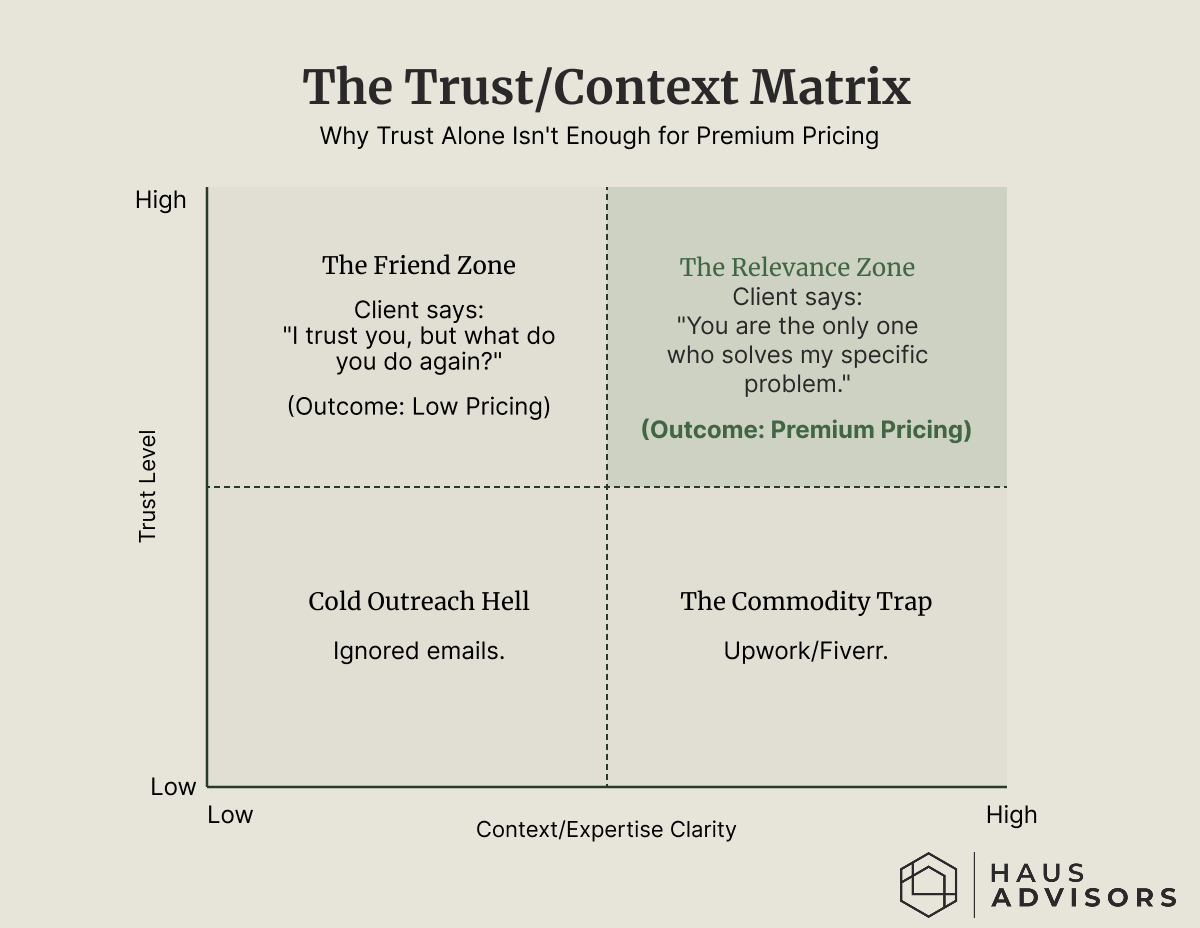
The geometry of referral pricing: Referrals put you in the top-left quadrant: trusted but uncontextualized. Premium pricing requires both trust AND context. The goal isn't to replace referrals. It's to move them from the Friend Zone to the Relevance Zone by giving your referrers the language to contextualize your value.
The agencies I see charging premium rates on referred work aren't the ones with more referrals. They're the ones whose market presence supplies the context that the referrer doesn't. The prospect gets the warm introduction AND then finds published case studies, a clearly positioned website, and content that demonstrates expertise in their specific problem. The referral opens the door. The context, built independently, fills in everything the referrer couldn't articulate.
Why Referrals Feel Like Enough
Because the close rate is so high. Referred prospects close at 50 to 70 percent for most agencies. That number makes referrals feel like the best channel by a wide margin, and in raw conversion terms, it is. No cold channel will match it.
But close rate is a deceptive metric when it masks margin quality. If your referred clients close at 65% but come in at 20% lower average deal value than clients acquired through other channels, the conversion advantage is significantly less impressive than it appears. You're closing more deals at worse terms, and the volume of deals is outside your control.
In the early years, this tradeoff made sense. You needed deals. Any deals. The trust advantage of referrals was enough because your capacity was small and your pricing wasn't sophisticated enough for the context gap to matter. A project was a project. Revenue was revenue.
But as your agency matures and your expertise deepens, the context gap becomes increasingly expensive. You're delivering specialized work at generalist prices because the way you're introduced doesn't reflect the value you've built. The referrer says "great dev team" and the prospect hears "reliable vendor," not "expert in my specific problem." The framing of the introduction determines the framing of the pricing conversation, and you're letting that framing be set by someone who doesn't understand your positioning.
What the Context Gap Actually Costs You
Margin suppression on your warmest leads. The leads you should be closing at the highest margins are instead closing at average or below-average margins. The trust advantage that makes referrals close quickly also makes them close cheaply, because the prospect arrives with an expectation anchored to "agency rates" rather than "specialist rates."
Network saturation without network expansion. Referrals draw from a finite pool. Each client knows a limited number of people who need your services, and after a few years, you've either been introduced to them or they've found other solutions. The math is straightforward: a referral network decays as contacts change roles, lose touch, or simply run out of relevant introductions. Without independent demand generation, you're drawing from a shrinking reservoir.
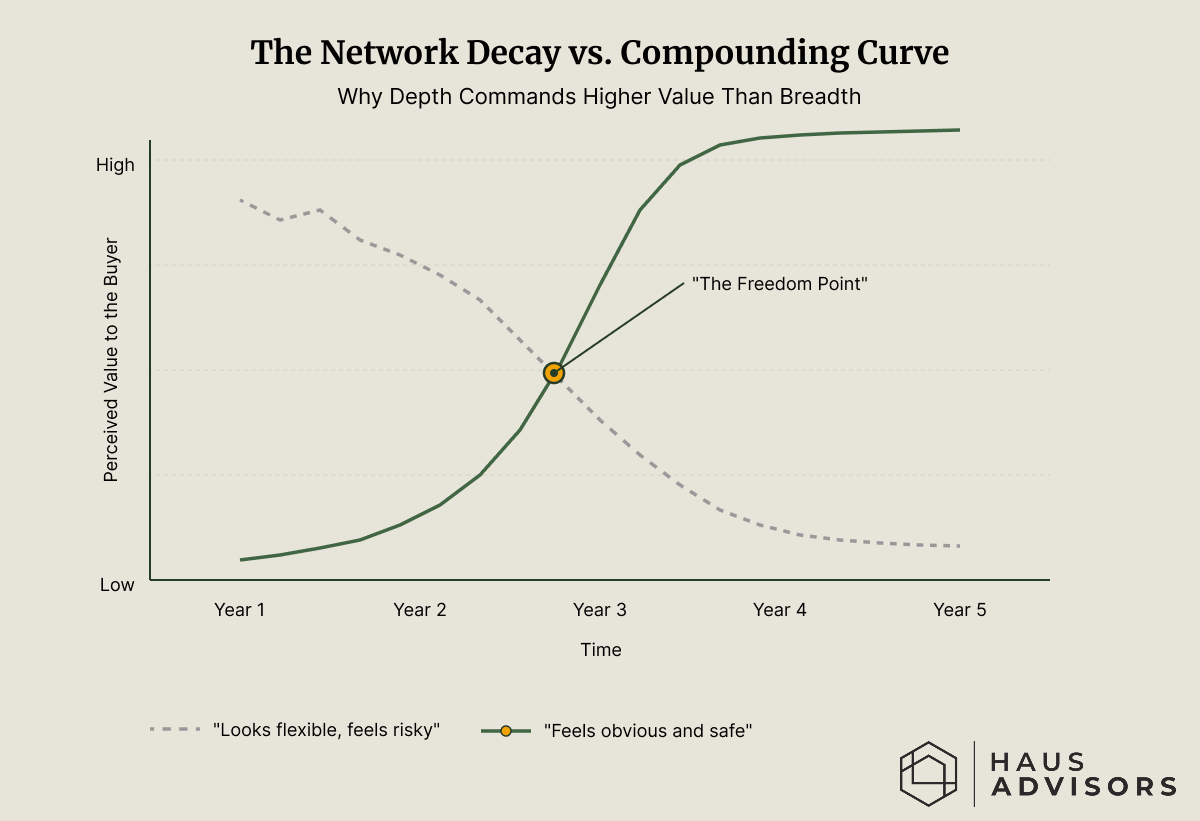
The decay curve: Referrals draw from a finite network that depletes over time. A positioning-driven system compounds because content, credibility, and partnerships generate demand independently of any single person's willingness to make an introduction.
The "friend of a friend" price anchor. This is the subtlest and most persistent cost. When a prospect is introduced through a personal connection, the social dynamics of the relationship create downward pressure on pricing. The prospect expects "friend rates" or at minimum resists premium pricing because the introduction felt casual rather than professional. They're hiring the person their friend recommended, not engaging a specialist their research identified. The psychological framing is different, and it directly impacts what they're willing to pay.
Founder dependency that compounds over time. Most referrals flow through one or two people, usually the founder. The referral network is personal, not institutional. This means the entire pipeline is tethered to the founder's relationships, memory, and availability. As the agency grows, this creates the classic bottleneck: the person who needs to be running the business is also the person whose relationships generate every new deal.
These aren't signs that referrals are bad. They're signs that referrals, as a sole growth channel, have structural limitations that become more expensive as the agency matures.
Volume vs. Context
This is the part most people miss.
When agencies recognize that referrals aren't scaling, their first instinct is to treat it as a volume problem. Not enough referrals. Need more introductions. Should ask clients more systematically. Should build a referral program.
But the deeper issue isn't volume. It's context. Even if you doubled your referral volume tomorrow, every new referral would arrive with the same structural limitation: high trust, low context. More introductions would produce more conversations, but those conversations would still be anchored to generic pricing because the prospect still doesn't understand what makes your agency specifically valuable for their specific situation.
The fix isn't more referrals. The fix is more context, built independently of the referral itself.
That context comes from three places:
A market presence that fills in what the referrer can't articulate. When a referred prospect Googles your agency after the introduction and finds a website that clearly states who you serve, what problem you solve, and what outcomes you produce, the context gap closes before the first conversation. They arrive knowing you're a specialist, not a generalist. The pricing conversation starts from a different baseline.
Content that demonstrates expertise in the prospect's specific problem. A referred prospect who has also read two of your case studies about solving their exact challenge arrives with context the referrer couldn't provide. They understand your approach. They've seen your results. They're evaluating fit, not vetting competence. That shift, from vetting to evaluating, is the difference between a price-focused conversation and a value-focused one.
Productized entry points that anchor the first engagement to defined value. When a referred prospect encounters a clear offering (a Technical Architecture Audit, a Conversion Diagnostic Sprint) with defined scope and pricing, the "friend of a friend" price anchor gets replaced by a professional anchor. The prospect evaluates a specific deliverable, not an ambiguous relationship. That structure protects margins in a way that no amount of referral volume can.
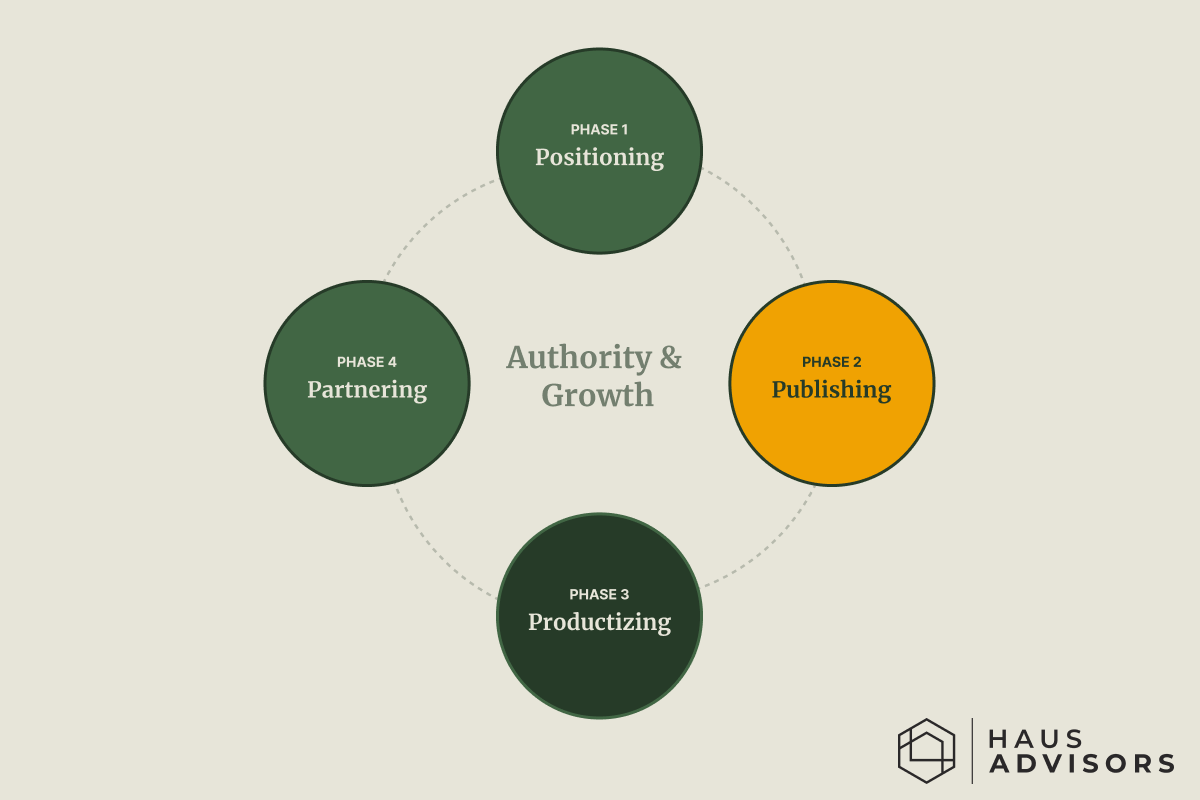
The compounding system: Unlike referrals, which produce linear returns from a depleting network, the flywheel produces compounding returns. Positioning makes publishing effective. Publishing makes productization credible. Productization makes partnerships precise. Partnerships generate introductions with both trust and context.
The goal isn't to replace referrals. It's to surround them with enough independent context that every referred prospect arrives understanding your specialized value, not just your personal trustworthiness.
The Honest Objection
Here's the strongest argument against investing in context-building when referrals are working: the ROI calculation doesn't favor it. Referrals are free. Content, positioning work, and partnership development cost time and money. If referrals are producing deals at a 65% close rate, why invest in channels that will close at 20% or 30%?
The math is straightforward: the channel with the highest conversion rate should get the most investment. And by that logic, referrals win every time.
Where That Logic Hits a Wall
But that math only holds if you measure channels by conversion rate alone and ignore margin quality, deal size, and pipeline control.
A referred deal that closes at 65% but comes in at $80K is worth less than a positioning-sourced deal that closes at 30% but comes in at $150K, because the positioning-sourced prospect arrived with context that justified premium pricing. The total revenue per lead is higher even though the conversion rate is lower.
More importantly, the positioning-sourced pipeline is under your control. You can increase it by publishing more, building more partnerships, refining your offerings. You can't increase referral volume in any systematic way. You can only wait and hope.
The agencies that break through the referral ceiling don't abandon their referral channel. They build context around it so that the warm introduction and the market presence work together. The referral opens the door. The positioning, content, and productized offerings fill the room with evidence that justifies premium pricing. The close rate stays high. The deal value goes up. And for the first time, the pipeline has a component the founder controls.
The Next Step
You don't need to overhaul your referral strategy. You need to test whether the Context Gap is suppressing your margins on referred deals.
Start here: pull up the last ten deals you closed through referrals. Calculate the average deal value. Then pull up any deals you've closed through other channels (content, partnerships, direct outreach, inbound) and calculate that average. If the non-referral deals are consistently higher in value, the Context Gap is active.
The next question is whether referred prospects are finding independent context about your agency after the introduction. Google your agency as if you were a referred prospect with no prior knowledge. Does your website clearly state who you serve and what problem you own? Can you find case studies that demonstrate business impact? Is there published content that shows your thinking on the specific problems your clients face?
If the answer is yes, your referrals are contextualized. If the answer is no, every warm introduction is arriving without the framing that justifies your real value. And the margin data will confirm it.
The principle is simple:
There are agencies that grow through trust alone, and there are agencies that grow through trust plus context.
The first model closes deals. The second model closes deals at the right price.
There's a second reason to build the context, and honestly it's the one I'd push hardest on. Referrals run through your relationships, so the whole pipeline is tied to your memory and your calendar. Context the market holds is context the agency owns. It keeps working in the months you're too busy to work a room. If you want your agency to grow without needing you in every deal, that's what the Relevance Engineering Program is built for. Book a call to see if it's a fit.
Keep reading
Browse by topic
- Positioning & Strategy
- Lead Gen & Marketing
- Sales & Biz Dev
- Pricing & Productization
- Research & Data
- Operations & Delivery
- Client Retention & Expansion
- Leadership & Culture
For founders whose agency has outgrown referrals.
One idea a week that makes a hard growth problem obvious, usually with a chart that shows you the mechanism behind it.
Built from conversations with seventy-plus agency founders on the Behind the Agency podcast.