The Strategy That Got You Here Is Now the Thing Holding You Back
I was talking to a founder last month who had built his agency to $2.5M through sheer force of will. Fourteen-hour days. Every sales call. Every major client relationship. Every scope decision running through him. He was exhausted but proud, and his question was simple: "How do I get to $5M?"
My answer wasn't what he wanted to hear. I told him the playbook that built the first $2.5M wasn't just insufficient for the next $2.5M. It was actively blocking it. The habits, instincts, and operating model that got him here were now the ceiling he was hitting.
He pushed back. "But this is what works. I just need to do more of it."
That belief has a name.
The Pattern: The Linear Growth Fallacy
Most agency founders operate under an implicit assumption that growth is a straight line. If hustle got you to $1M, ten times the hustle gets you to $10M. More leads plus more bodies equals more profit. The math feels intuitive. It's also wrong.
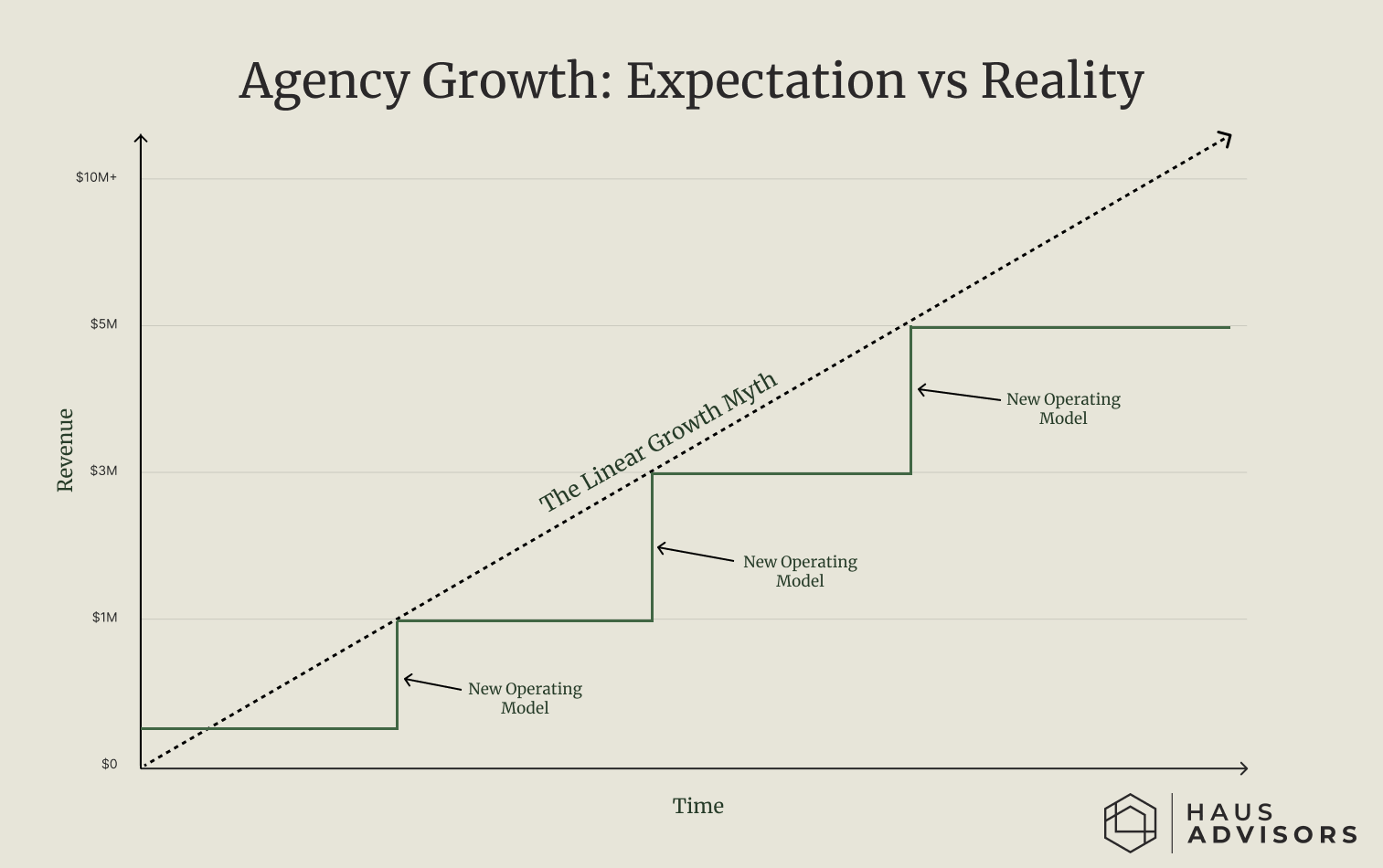
Visualizing the fallacy: Founders assume growth scales linearly with effort. In reality, each stage of agency growth requires a fundamentally different operating model, and the strategy that produced the last million becomes the constraint on the next one.
Based on conversations with nearly 70 agency founders, growth isn't linear. It's a step-function. There are four distinct stages, and each one requires a different operating model: a different approach to sales, a different relationship between the founder and the business, a different definition of what "good" looks like.
The founders who get stuck aren't the ones who lack talent or effort. They're the ones applying a Stage 1 operating model to a Stage 3 problem. They're doing the right thing at the wrong altitude.
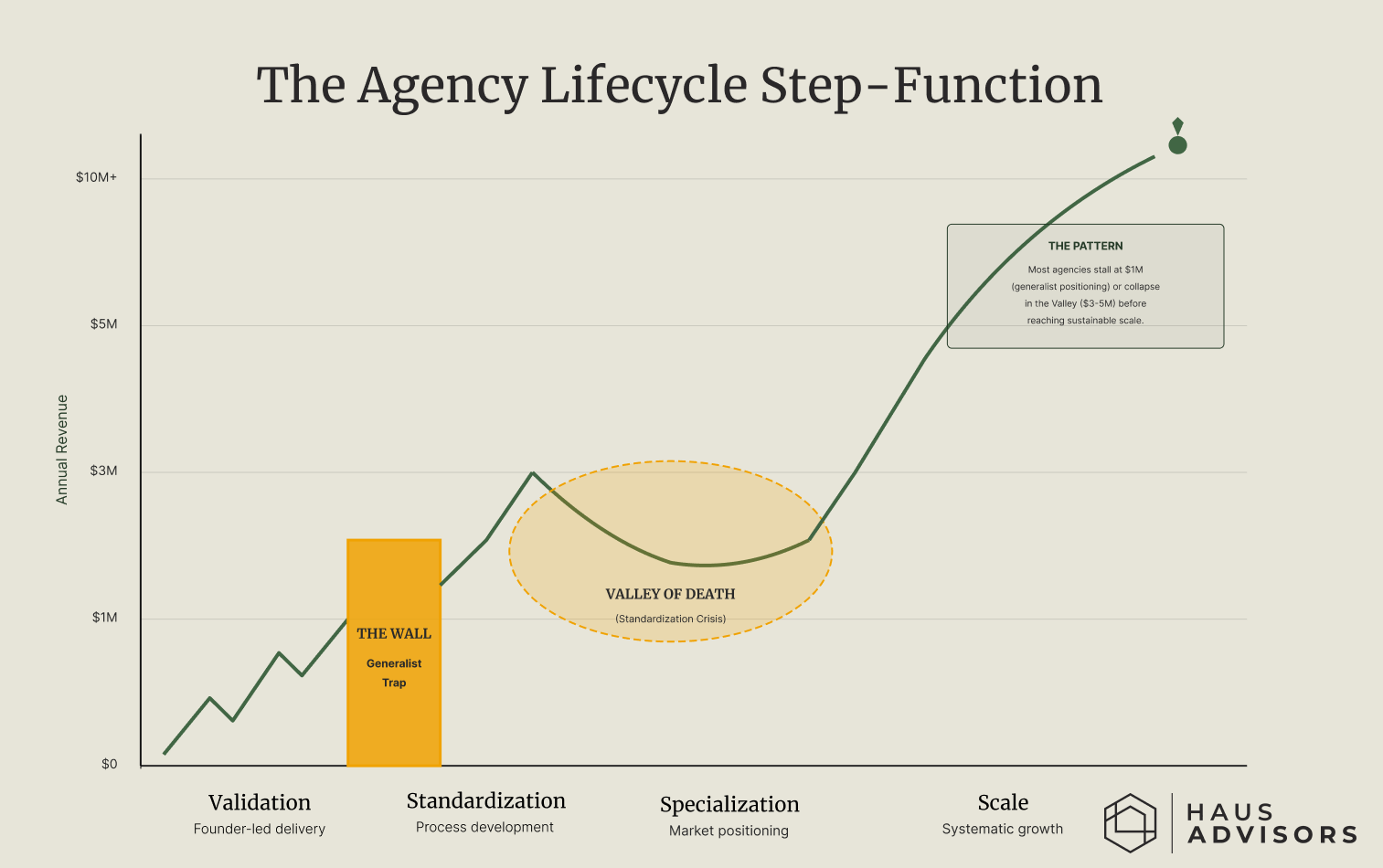
The law of the room: You don't just need more leads to scale. You need to swap your operating model four times. Each step-function transition requires the founder to release the strategy that produced the previous stage of growth.
This is the part that makes the Linear Growth Fallacy so persistent: the strategy that works at each stage doesn't just stop working at the next stage. It becomes the anchor. The hustle that built $1M creates founder dependency at $2M. The founder-led positioning that broke $3M creates a management bottleneck at $5M. The pattern repeats at every transition, and it always feels like the same problem (not enough growth) when it's actually a different problem each time (wrong operating model).
Why You're Running the Wrong Playbook
Because the current one has evidence on its side. You hustled to $1M. The hustle worked. The instinct to do more of what worked is rational. It's also the exact instinct that keeps agencies stuck at plateaus for years.
In Stage 1, saying yes to everything was survival. In Stage 2, that same instinct produces a delivery team that reinvents the wheel every week because nothing is standardized. In Stage 3, the founder's direct involvement in every decision, the thing that ensured quality in earlier stages, becomes the constraint that makes quality impossible to maintain at scale.
Each stage's strength becomes the next stage's liability. And the transition between stages isn't a matter of working harder. It's a matter of releasing the operating model that got you here and adopting one you haven't proven yet. That's an identity shift, not an effort shift. And identity shifts are the hardest thing a founder can do.
The Four Operating Models
Stage 1: Validation ($0 to $1M)
The operating model: Hustle.
You don't have a business yet. You have a hypothesis that you and a small team need to validate with cash. The defining feature of this phase is existential anxiety. You're fighting for oxygen.
The temptation here is what I call "playing business": spending weeks on logos, five-year strategic plans, and CRM automations for traffic that doesn't exist yet. This feels productive. It produces zero asset value. It's a defense mechanism against the discomfort of asking strangers for money.
At this stage, the work is simple and uncomfortable. Your lead source is high-friction outbound: podcasting, personal networking, cold outreach. You don't have domain authority for SEO or cash reserves for ads. You build pipeline by hand.
Your offer is "yes." You're a generalist because you need cash flow more than positioning. You're getting paid to discover what you're actually good at.
Your team is you. Founder-led sales is the only option. You can't outsource the selling of a vision that hasn't been proven. If you're automating a process you haven't personally executed fifty times, you're wasting time.
Your metric is cash flow. Ignore LTV/CAC ratios. Your job is to keep the lights on and demonstrate to the outside world that you offer something of value.
Stage 2: Standardization ($1M to $3M)
The operating model: Positioning.
If the theme of Stage 1 is saying "yes" to survive, the theme of Stage 2 is saying "no" to scale.
You survived the hustle. You have revenue. But you've almost certainly fallen into the Generalist Trap. You got here by responding to every client request, which means your delivery team is reinventing solutions weekly for problems you should have solved ten times already.
The founder is now the bottleneck. "How we do things" lives only in your head. You can't take a vacation without the business limping. You can't run a sales process without being in every meeting. I call this the Brick Wall: the invisible ceiling created by the founder's refusal (or inability) to extract their knowledge into systems others can run.
At this stage, your lead source shifts from outbound hustle to niche inbound. Referrals are good but passive. To break $3M, you need to attract a specific type of client through published expertise. This means prospects who value your specific knowledge, not just your availability.
Your offer transitions from "whatever you need" to productized services. You move from selling hours to selling outcomes. This requires ruthless positioning. You cannot standardize "we do whatever you want."
Your team priority is delivery delegation. The founder steps out of delivery. The process gets mined out of your brain and documented so a team can execute without your constant oversight.
Your metric is gross margin. Revenue is vanity; margin is sanity. Standardization reduces delivery costs and expands margins, creating the capital you need to hire management in the next phase.
Stage 3: Delegation ($3M to $10M)
The operating model: Management.
This is the agency Valley of Death. The place where most good agencies go to stall or die.
The informal communication structures that worked for a team of ten disintegrate at thirty people. When you were small, everyone knew what everyone else was doing through proximity. Now nobody knows anything. Quality slips. Culture frays. Long-tenured employees lose connection with what feels like a "new corporate vibe."
The fatal mistake here is applying Stage 1 logic (work harder, be the hero) to a Stage 3 problem (organizational complexity). You cannot out-hustle a broken org chart.
At this stage, your lead source becomes scalable outbound and marketing. The founder can no longer be the sole rainmaker. You need a dedicated marketing function that supports a sales team and keeps the pipeline full regardless of the founder's availability.
Your offer moves upmarket. You're no longer pitching projects. You're pitching strategic partnerships that move the needle on your client's business. This requires a level of polish, reporting, and sophistication that hustle alone cannot produce.
Your team priority is a second layer of leadership. Sales directors. Marketing leads. But the critical distinction here: do not hire clipboard managers. People who manage process but can't execute it. What you need are player-coaches who can close deals, build systems, and earn the team's trust through demonstrated competence.
Your metric shifts to net profit and retention. The focus moves from "winning deals" to "organizational health." Are employees staying? Can the machine deliver quality without the founder in the room? Is the second layer of leadership making good decisions autonomously?
Stage 4: Liquidity ($10M+)
The operating model: Engine.
At $10M+, the challenge transforms from delivery to volume. You're feeding a machine that requires $2M to $3M in new revenue annually just to replace natural churn and stay flat.
The danger at this stage is commoditization. You become a vendor fighting on price through RFP battles, rather than a partner competing on value. It can feel like the "soul" of the agency is at risk when conversations center on utilization rates and billable efficiency.
At this stage, your lead source must be a diversified engine. Inbound, outbound, partnerships, and brand all running simultaneously. If one channel contracts, the others absorb the load. Single-channel dependency at this scale is existential risk.
Your offer becomes brand equity. Clients are no longer buying the founder. They're buying the firm. The brand is the asset that carries trust. The logo on the invoice matters more than who signed the contract.
Your team priority is a specialized Chief Revenue Officer who treats sales as a math problem, not an art form. The founder transitions from closer to brand ambassador.
Your metric is EBITDA and enterprise value. You're building an asset that can be sold or run without you. Private equity pays premiums for engines, not hustlers. If revenue stops when you leave the room, you don't have a business. You have a high-paying job.
The Real Transition Problem
The math of scaling an agency is well-documented. Thousands of firms have proven the playbook at each stage. The reason most agencies stall at $2M or $5M isn't a knowledge gap. It's an identity gap.
Every stage transition requires the founder to release the role that defined their contribution at the previous stage.
From Validation to Standardization: you stop being the hero who saves the client and become the architect who designs the process. From Standardization to Delegation: you stop trusting only your own intuition and start trusting the data your managers report. From Delegation to Liquidity: you stop being the closer and become the brand.
Each transition feels like a loss before it feels like leverage. When you stop coding and start managing, you feel less productive. When you stop running sales calls and start building brand assets, you feel less busy. That discomfort isn't a sign of failure. It's the sensation of moving to a higher-leverage position in the business.
The Honest Objection
Here's the strongest argument against this framework: real agencies don't fit neatly into four boxes. Revenue stages overlap. Some agencies have Stage 3 complexity at $2M because they took on enterprise clients early. Others run lean at $5M and never hit the management crisis. The step-function model oversimplifies messy reality.
That's fair. No framework perfectly maps the territory. Revenue thresholds are approximations. The transitions don't happen at clean dollar amounts.
Where That Logic Hits a Wall
But the sequence holds, even when the dollar amounts don't. Every agency I've worked with has gone through these operating model transitions in this order. The triggers vary. The revenue at which they hit each wall varies. But the pattern of strategy-becomes-anchor is universal.
The framework isn't meant to predict exactly when each transition will happen. It's meant to help you recognize which operating model you're currently running, whether it's the right one for your current stage, and what the next transition looks like so you can prepare for it instead of being blindsided by it.
The founders who navigate these transitions well aren't the ones who follow the framework perfectly. They're the ones who recognize when their current operating model has stopped producing returns and have the discipline to change it before the plateau becomes a decline.
The Next Step
Look at your calendar for the past two weeks. List everything you spent time on. Then ask one question: is this the work of a founder at my current revenue stage, or am I doing the work of a stage I've already outgrown?
If you're a $2.5M founder still personally running every sales call and scoping every project, you're operating a $1M playbook. If you're a $5M founder still making every delivery decision because "nobody else understands the clients," you're running a $2M playbook.
The gap between where your revenue is and where your operating model is tells you exactly which transition you're resisting. And the transition you're resisting is almost always the one that unlocks the next stage of growth.
The principle is simple:
There are founders who try to outwork each stage, and there are founders who outgrow each stage.
The first group hits the same ceiling harder. The second group changes the game.
Most founders reading this already know the real problem. It isn't which playbook you're running. It's that the reputation, the relationships, and the judgment that make your agency worth hiring still live in your head. So the business only grows when you're in the room. That's the Brick Wall from Stage 2, and it's the transition most founders never make.
That's the work we do at Haus Advisors. The Relevance Engineering Program is six months of implementation, not a strategy document. We pull what makes your agency relevant out of your head, build it into positioning, offers, and growth plays your team can run, and hand ownership to them. If you want an agency that grows without needing you in every deal, book a call to see if it's a fit.
Keep reading
Browse by topic
- Positioning & Strategy
- Lead Gen & Marketing
- Sales & Biz Dev
- Pricing & Productization
- Research & Data
- Operations & Delivery
- Client Retention & Expansion
- Leadership & Culture
For founders whose agency has outgrown referrals.
One idea a week that makes a hard growth problem obvious, usually with a chart that shows you the mechanism behind it.
Built from conversations with seventy-plus agency founders on the Behind the Agency podcast.