The Reason Marketing "Doesn't Work" for Your Agency
A founder I work with spent $30K last year trying to scale beyond referrals. He hired a lead gen firm. He ran LinkedIn ads. He invested in a content writer to publish weekly blog posts. At the end of twelve months, virtually every closed deal still traced back to a personal introduction.
His conclusion: "Marketing doesn't work for agencies like ours. We're a relationship business."
He wasn't wrong about the relationship part. He was wrong about why the marketing failed.
The lead gen firm booked meetings with people who had no idea who he was and treated him like a commodity vendor. The LinkedIn ads for "custom software development" put him in a bidding war with offshore firms spending ten times his budget. The blog posts attracted other developers, not the CEOs who actually sign checks. Every tactic did exactly what it was designed to do — generate exposure. The problem was that exposure, without context, produced nothing.
The marketing didn't fail because the channels were wrong. It failed because his agency had no independent gravity. Nothing in his market presence gave a stranger a reason to pay attention, let alone trust him enough to start a conversation.
The Pattern Has a Name
I call it The Gravity Gap — the absence of independent market pull that becomes visible the moment an agency tries to grow beyond its personal network. Referrals mask this gap for years because they come pre-loaded with trust. Someone else's credibility does the work that your market presence would normally need to do. The close rates are high. The sales cycles are short. Everything feels like it's working.
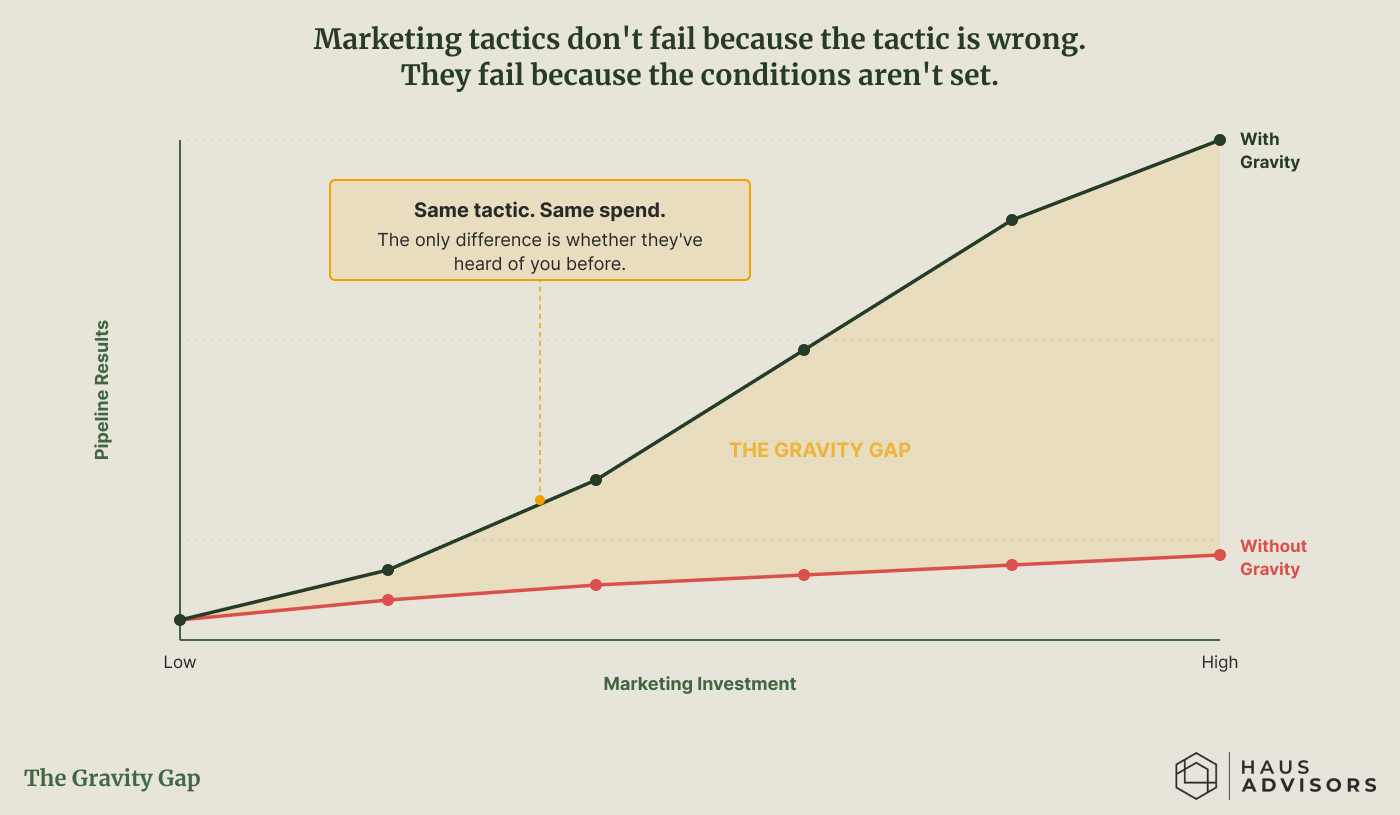
The same marketing investment produces completely different results depending on whether the market already knows who you are. Without gravity, every tactic starts from zero. With it, the same spend compounds.
But referrals aren't building your gravity. They're borrowing someone else's.
Every referral adds to the referrer's network value, not your market presence. You're an extension of their reputation, not an authority in your own right. The prospect heard "I know a guy who builds apps" — which puts you in a price-comparison bucket from the first conversation. You're being evaluated on availability, not expertise.
This works until you need to grow beyond what your network can organically produce. And the moment you turn to cold channels — outbound, ads, content, partnerships — the Gravity Gap is exposed. Strangers don't have the referrer's trust to lean on. They need to see your gravity for themselves. And if there's nothing there — no clear positioning, no demonstrated expertise, no reason to choose you over a cheaper alternative — the channel fails. Not because the channel is broken. Because there's nothing for the channel to amplify.
Why You Haven't Built Gravity Yet
Because referrals made it unnecessary. For years, your growth came through warm introductions from people who already trusted you. You didn't need positioning because your relationships were your positioning. You didn't need content because your conversations were your content. You didn't need to explain your differentiation to strangers because you never had to sell to strangers.
That wasn't a mistake. It was appropriate. In the early years of an agency, personal relationships are the highest-leverage growth channel available. Building gravity — market positioning, published expertise, productized offerings — would have been premature when your capacity was small and your ideal client was still undefined.
But the habits that were appropriate when you were small have become the constraints that keep you there. You now have a team, a track record, and genuine expertise — but no mechanism for making any of that visible to people who don't already know you. The agency has substance without signal. And substance without signal, in a cold market, is invisible.
What the Gravity Gap Actually Costs You
Every cold channel underperforms. Outbound emails get ignored because the recipient has no context for who you are. Content gets read by peers, not buyers, because it demonstrates technical skill rather than business impact. Ads compete on category terms where you're outspent by firms with ten times your budget. You're spending money to be visible in rooms where you have no differentiation — which is worse than being invisible, because it trains you to believe the channels don't work.
The "marketing doesn't work for us" conclusion. This is the most expensive consequence of the Gravity Gap, because it sends you back to referral dependency with conviction. You tried outbound — it produced bad-fit meetings. You tried content — it attracted developers, not decision-makers. You tried ads — they burned budget. The evidence seems clear: marketing doesn't work for relationship businesses. Except it does. It just doesn't work without gravity.
Permanent dependence on borrowed trust. Without independent gravity, your pipeline is controlled by other people's timing, memory, and willingness to make introductions. You can't forecast. You can't hire ahead of demand. You can't confidently invest in capacity because you have no way to predict whether the introductions will keep coming. You're not scaling — you're waiting.
These aren't marketing failures. They're gravity failures that surface during marketing attempts.
Borrowed Trust vs. Built Trust
This is the part most people miss.
Referral-dependent agencies run on borrowed trust — credibility that someone else earned, lent to you for a single introduction, and that evaporates the moment the prospect starts comparing you to other options. It's powerful in the moment and leaves nothing behind.
Built trust is the gravity you create through your own market presence: positioning that tells a stranger exactly who you serve and why, content that demonstrates your thinking on the problems your buyers face, productized offerings that make it easy to say yes, and partnerships that generate introductions from people who understand precisely when to refer you.
Borrowed trust gets you in the room. Built trust is the reason they stay.
The transition from borrowed to built isn't about abandoning referrals. It's about building something underneath them — so that when a stranger encounters your agency through any channel, they find substance, clarity, and a reason to engage that doesn't depend on someone else's endorsement.
That transition has three layers:
Positioning that creates recognition. A clear, specific answer to "who do you serve and what problem do you own" that a stranger can understand in seconds. This is what turns a cold email from "I help businesses grow" into "I noticed you just raised a Series A for your fintech platform — most firms at your stage hit a bottleneck with banking API security. We just solved this for [similar company] in four weeks." The positioning makes the specificity possible. Without it, every outreach attempt defaults to generic.
Content that demonstrates authority to buyers, not peers. The shift is from writing about the technology to writing about the business impact. "How to Use React Hooks" attracts developers. "How we reduced API latency by 60% for a fintech startup, saving them $12K/month in server costs" attracts the people who fund development work. Your content's job isn't to prove you can code. It's to prove you understand the business problems that make coding worthwhile.
Productized offerings that remove friction from the first engagement. Custom scoping kills conversion on cold channels because the prospect doesn't know what they're buying, what it costs, or what they'll get. A defined entry point — a Technical Audit and 90-Day Roadmap, an MVP Scoping Sprint — gives them something concrete to evaluate. It shifts the founder's role from "architect of every engagement" to "designer of a repeatable system that others can deliver."
The Honest Objection
Here's the strongest argument against this approach: building gravity takes time. Positioning sprints take weeks. Content authority takes months. Partnership development takes quarters. If your pipeline is thin right now, investing in gravity feels like planting trees while the house is on fire.
And there's a second layer to this objection: referrals work. Your close rates on referred deals are probably 60–70%. No cold channel will match that. Why invest in building gravity when the warm channel outperforms everything else by a wide margin?
Where That Logic Hits a Wall
Both points are partially true, and both miss the structural issue.
Yes, gravity takes time to build. But the alternative, continuing to run cold channels without gravity, doesn't save time. It burns it. Every month of undifferentiated outbound, generic content, and unpositioned ads is a month of budget spent on channels that can't convert. The time investment in gravity isn't additional — it replaces the time you're currently wasting on tactics that fail without it.
And yes, referrals close at higher rates. They always will. The goal isn't to replace referrals with cold channels. It's to build enough independent gravity that you're no longer dependent on referrals — so that when they slow down (and they will), you have a pipeline that doesn't slow down with them. Gravity doesn't compete with referrals. It removes the fragility of relying on them exclusively.
The agencies I've watched break through this ceiling didn't choose between referrals and marketing. They built gravity that made both more effective — referrals closed even faster because the prospect had already seen their content, and cold channels actually converted because the positioning gave strangers a reason to engage.
The Next Step
You don't need to build a marketing machine this quarter. You need to test whether your agency has any independent gravity.
Start here: find someone who has never heard of your agency — a friend of a friend, someone outside your industry, anyone without context. Show them your website for thirty seconds. Then ask them two questions: "What does this company do?" and "Why would someone choose them over a cheaper alternative?"
If they can answer both clearly, you have the beginnings of gravity. The channels you build on top of it will work.
If they can't — if the answers are vague, generic, or require your explanation to make sense — you've just seen the Gravity Gap through a stranger's eyes. And now you know exactly what needs to change before any marketing investment will produce a return.
The principle is simple:
There are agencies that try to market their way beyond referrals, and there are agencies that build gravity first and let the marketing carry it.
The first group spends money on channels. The second group builds something the channels can amplify.
Keep reading
Browse by topic
- Positioning & Strategy
- Lead Gen & Marketing
- Sales & Biz Dev
- Pricing & Productization
- Research & Data
- Operations & Delivery
- Client Retention & Expansion
- Leadership & Culture
For founders whose agency has outgrown referrals.
One idea a week that makes a hard growth problem obvious, usually with a chart that shows you the mechanism behind it.
Built from conversations with seventy-plus agency founders on the Behind the Agency podcast.