Why Adding More Lead Channels Won't Fix Your Pipeline
There's a specific anxiety that hits an agency founder on the 20th of the month when the pipeline looks thin. You check your inbox, no new referrals. You check your bank account, payroll is due in ten days. You start doing the mental math on which contractor you might have to let go or whether you're going to pay yourself this month.
I know this feeling because I've sat across from founders in it dozens of times. And the move they almost always make next is the one that keeps them stuck.
They start adding channels. A LinkedIn content push. A batch of cold emails. A conference sponsorship. Maybe an outbound SDR on a trial basis. The logic is sound: if referrals aren't reliable, diversify. Spread across more channels and something will hit.
Three months later, they've spent money and energy across four or five channels, none of which are producing meaningful pipeline. The referrals are still carrying the business. The new channels feel like expensive experiments that didn't work. The conclusion: "We tried diversifying. It didn't work for us."
It didn't fail because diversification doesn't work. It failed because everything a channel needs to say (who you're for, what problem you own, the proof you've solved it before) still lived in the founder's head. The team could run the channel. Only the founder could give it something worth saying, and he was busy keeping the lights on.
The Pattern Has a Name
I call it The Scatter Effect, the instinct to spread across multiple lead channels before the strategic foundation exists to make any of them effective. It's the lead generation equivalent of turning up the volume on a bad signal. More channels, more effort, more noise, but no increase in clarity.
Here's the mechanism: every lead channel you add (content, outbound, partnerships, paid, community) requires the prospect to quickly understand who you are, what you do differently, and why they should care. If your positioning is vague, that understanding doesn't happen. The prospect sees a generic agency, files you alongside every other option, and moves on. It doesn't matter how many channels delivered that impression. A forgettable message, delivered five ways, is still forgettable.
The Scatter Effect is particularly cruel because it feels like progress. You're doing more. You're visible in more places. Your activity metrics are up. But activity and effectiveness are different things, and the gap between them widens with every channel you add before the positioning is right.
Why Scattering Feels Like the Right Move
Because it's what you do when the problem feels like volume. When referrals slow down and the pipeline thins, the most intuitive diagnosis is: we don't have enough leads coming in. And the most intuitive solution to "not enough leads" is: create more places where leads can come from.
That diagnosis made sense when you were small. In the early years, any lead from any source was a good lead. You didn't need positioning because you didn't need cold channels. Your network, your relationships, and your reputation did the work. Adding a channel back then was adding a relationship. A conference introduction turned into a client. A LinkedIn connection became a referral. The channel was just the mechanism for something personal.
But what worked when every channel was relationship-backed doesn't work when you're trying to scale beyond your personal network. Cold channels like content that strangers read, outbound to people who don't know you, partnerships with firms that haven't seen your work, require something your warm channels never did: instant clarity about who you are and why you're different.
Without that clarity, every cold channel you add is just another surface where your commodity positioning is exposed to people who have no reason to look twice.
What the Scatter Effect Actually Costs You
Wasted channel investment. Each channel you launch without positioning clarity burns budget and attention that could have gone toward one channel done well. The content doesn't convert because it's generic. The outbound doesn't land because the message sounds like fifty other agencies. The partnership conversations stall because your partner can't articulate when to refer you. You don't learn which channel works because none of them had a fair test, the signal was too weak to produce meaningful data from any of them.
The false conclusion that "diversification doesn't work." This is the most expensive cost, because it sends founders back to referral dependency with the belief that they've already tried the alternative. They haven't. They've tried adding channels without fixing the foundation, which is like testing whether a car runs by turning the ignition with no engine installed.
Founder demoralization. Three months of scattered effort across multiple channels, with nothing to show for it, is exhausting. It burns the energy and optimism that the founder needs for the longer-term work of building a real system. Many founders who come to me have already been through one round of "we tried everything", and the residue of that experience makes them skeptical of doing the actual foundation work, because it feels like more of the same.
These aren't marketing failures. They're sequencing failures. You built the channels before you built the thing that makes channels work.
Volume vs. Signal
This is the part most people miss.
Agencies that struggle with lead generation almost always frame it as a volume problem: not enough leads, not enough channels, not enough activity. But the agencies I've watched break through didn't solve a volume problem. They solved a signal problem.
Volume is how many people see you. Signal is how clearly they understand what you do and why it matters to them specifically.
A single channel with strong signal, one platform where your positioning is sharp, your content demonstrates genuine expertise, and your outreach targets people you're specifically built to serve, will outperform five channels with weak signal every time. Not because the channel is magic. Because the message is doing the work that volume alone can't do.
The shift from volume to signal requires four things. Think of them as the lens for which lever to pull first, because they have a specific order. And notice, as you read them, where each one lives in your agency today. In most founder-led agencies the answer is the same for all four: in the founder.
Positioning that passes the stranger test. Not a tagline exercise, a clear, specific answer to "who do you serve, what problem do you solve, and why should they choose you?" that a stranger can understand in seconds. If you can't complete the sentence "We help [specific type of company] solve [specific problem] by [specific approach]" without resorting to words like "full-service," "innovative," or "end-to-end," your positioning isn't ready for cold channels yet.
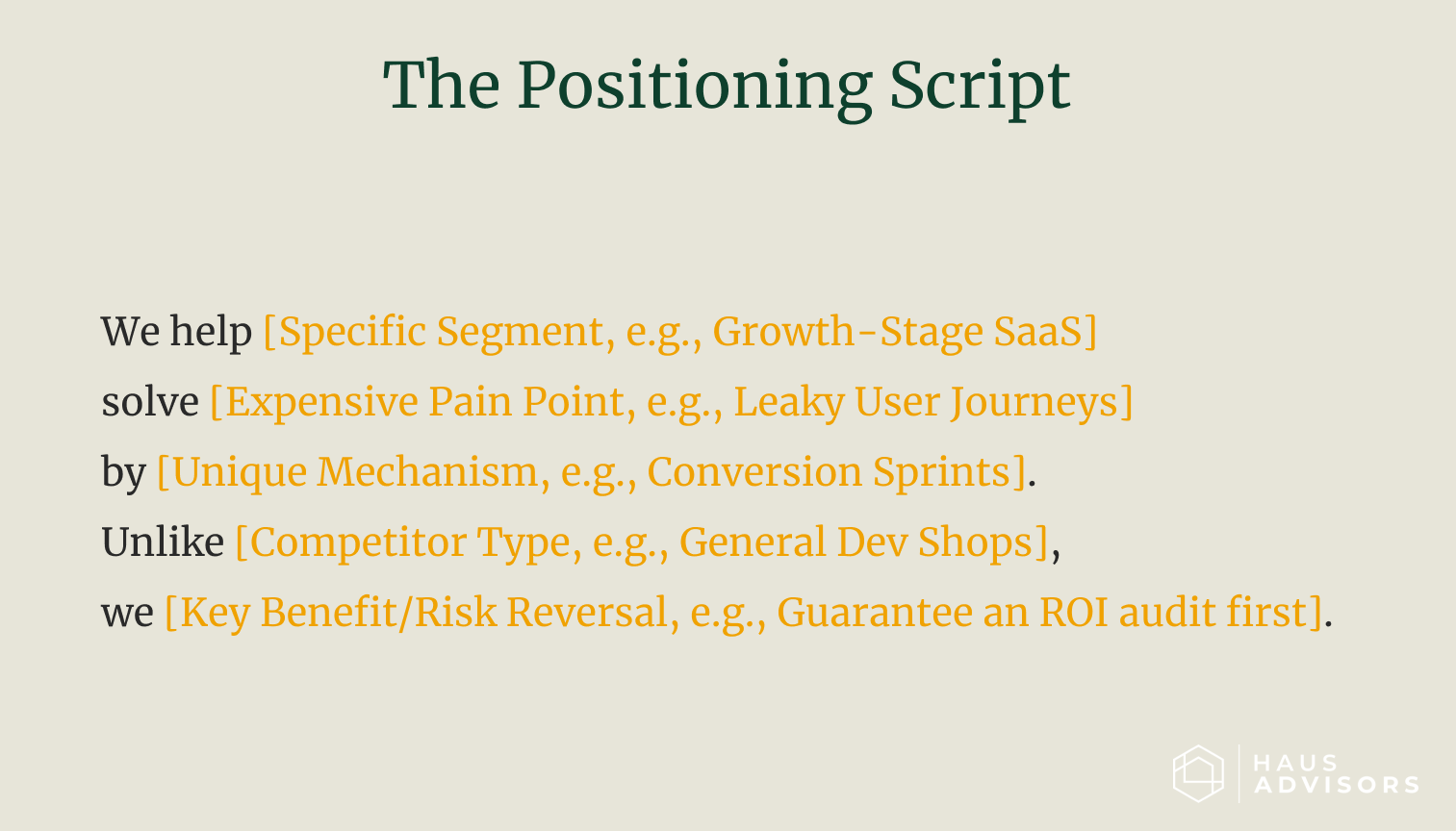
The 3-Second Test: if you can't complete this script without buzzwords, your positioning isn't sharp enough to make cold channels work. This is the filter that determines whether adding channels will produce signal or noise.
Content that demonstrates expertise, not existence. Your ideal buyers are evaluating you long before they reach out. They're reading your content to determine whether you actually understand their problem or whether you're just occupying space in their feed. The difference between content that builds pipeline and content that fills a publishing calendar is specificity, showing your thinking on the exact problems your positioning claims to solve, not posting generic updates about your industry.
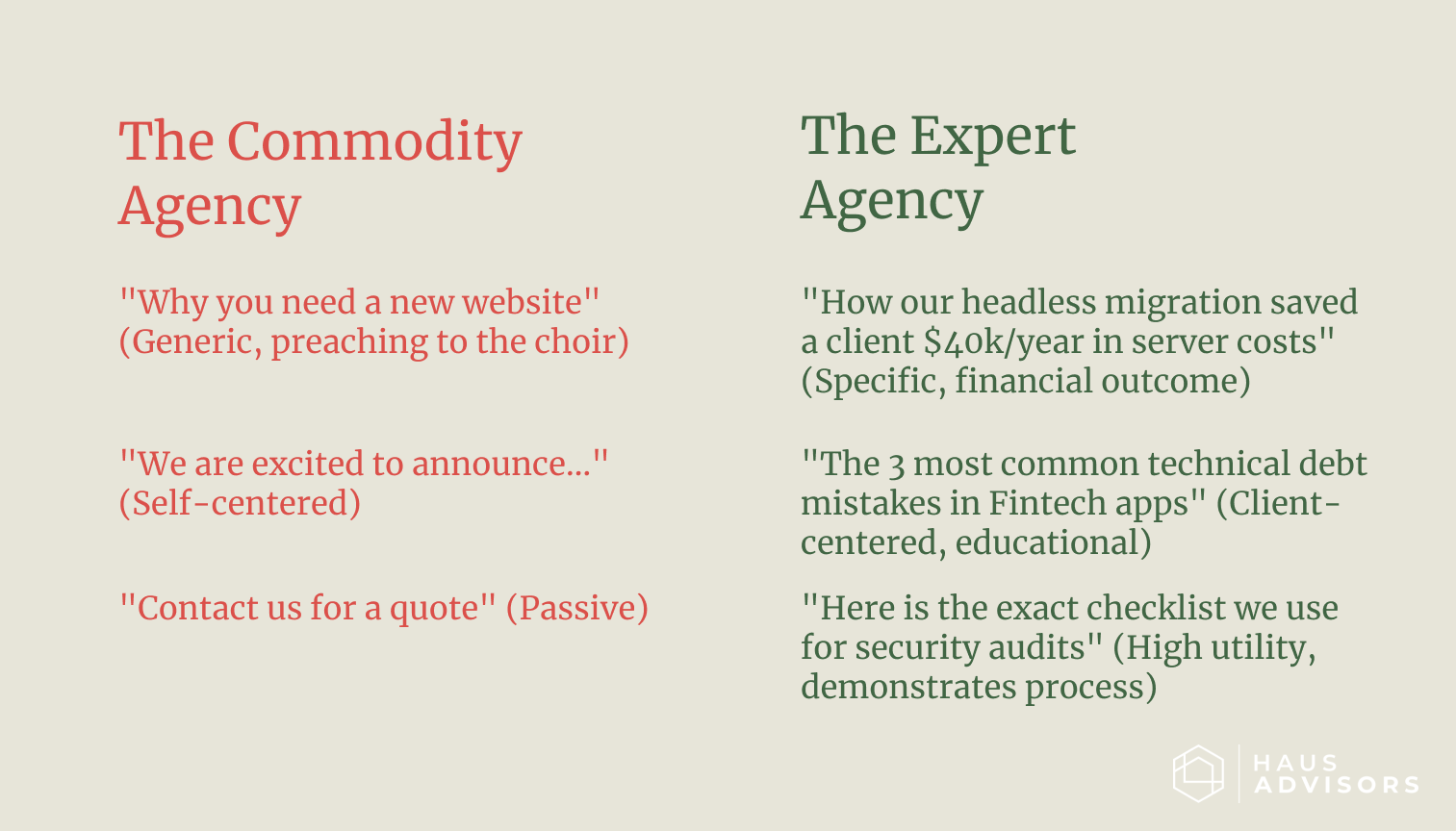
Visualizing the difference between noise and signal: generic updates get scrolled past. Specific, problem-solving content gets bookmarked by the exact people your positioning is designed to attract.
Productized entry points that lower the first commitment. It's hard to generate leads for "custom software development" because the prospect doesn't know what it costs, how long it takes, or what they're agreeing to. That ambiguity creates friction that kills conversion on every channel. A defined offering, a 30-Day Organic Traffic Audit, an MVP Scoping Sprint, a Technical Architecture Review, gives the prospect something they can evaluate, budget for, and say yes to without the risk of a six-figure commitment they don't understand yet.
Partnerships that leverage existing trust. Cold outreach is hard because you're asking a stranger to trust you. Warm introductions are easier because someone they already trust is vouching for you. The fastest path to lead diversification isn't building five new cold channels. It's building two or three relationships with complementary firms, the design agency that doesn't do backend work, the fractional CTO who needs an implementation partner, the platform vendor whose directory puts you in front of high-intent buyers.
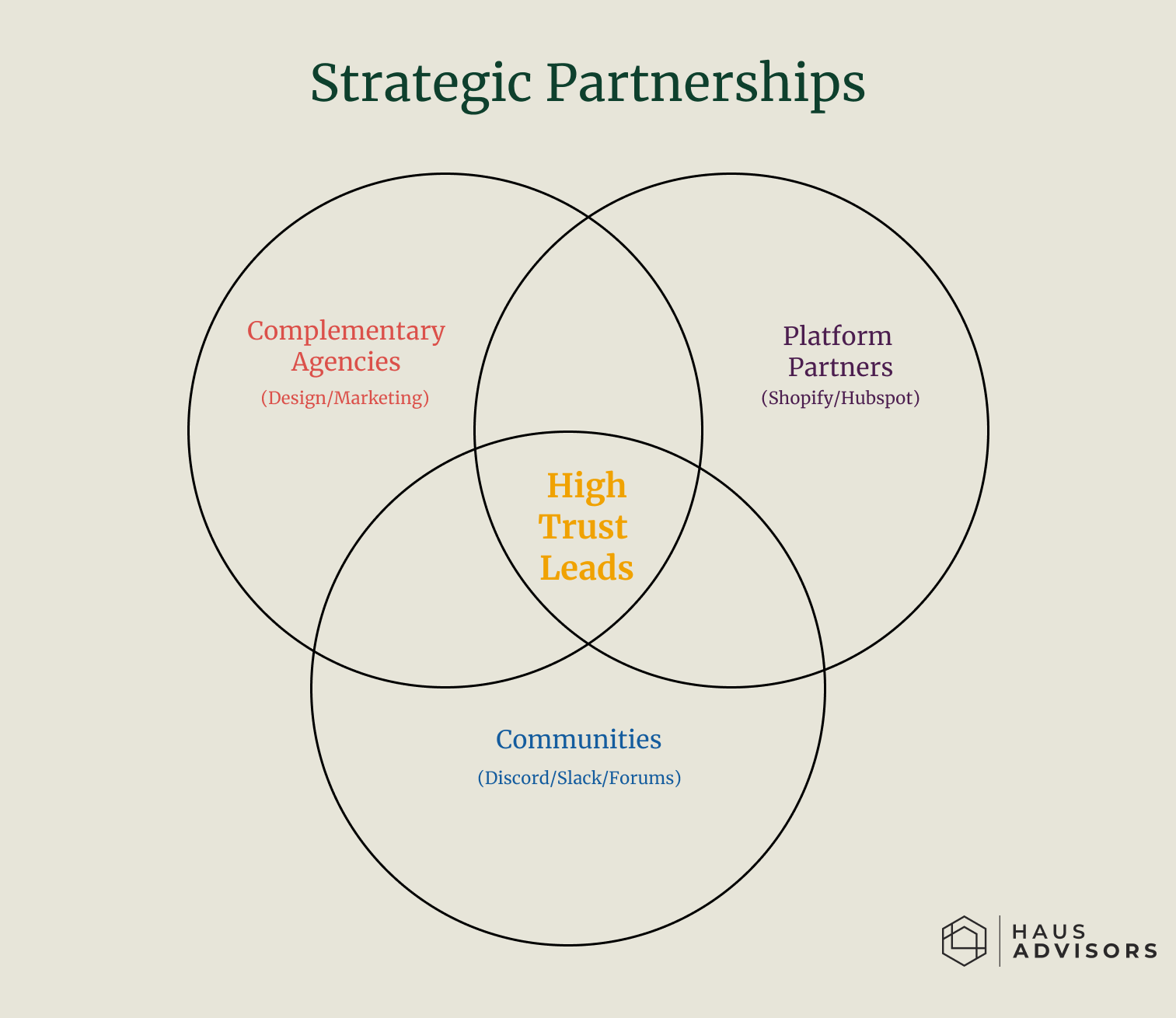
The geometry of warm introductions: stop trying to reach cold strangers directly. Start reaching the people those strangers already trust.
These four components aren't four separate projects. They're a sequence. Positioning makes content effective. Content makes outbound credible. Productized offers make conversion possible. Partnerships make reach scalable. Remove any one of them and the channels built on top will underperform, not because the channel is wrong, but because the signal is too weak.
But here's the part I got wrong for years. I treated this as a to-do list, four things to build. It's closer to a move. Each of the four already exists in your agency, in the form of what you know and who trusts you. The work is pulling it out of your head first (that's the Extract step) and only then building the channel around it (Engineer). Skip the first step and your team is running channels that can't carry a signal only you can send.
The 90-Day Path
If the sequencing matters as much as I'm arguing it does, then the implementation plan has to respect that sequence. Here's the order that works.
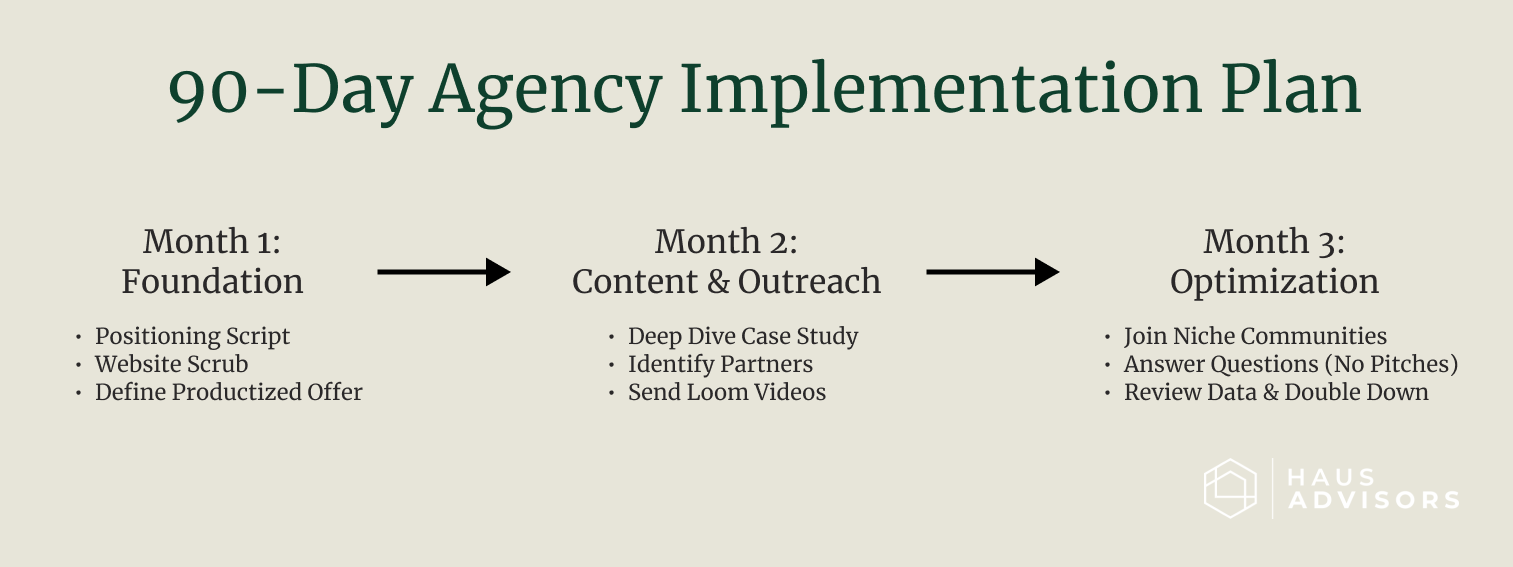
The roadmap: Month 1 fixes the foundation so that the channels you build in Month 2 actually have something to say. Sequencing isn't just strategic advice. It's the difference between channels that convert and channels that burn budget.
Phase 1: Foundation (Days 1–30). Complete the positioning script — be ruthless about specificity. Scrub your website; if it says "we work with everyone," change it. Define one productized entry-point offer with a clear scope, price, and outcome. This phase produces no leads. It produces the signal that makes lead generation possible.
Phase 2: Build and Partner (Days 31–60). Publish your first deep-dive case study that demonstrates expertise on the specific problem your positioning claims to solve. Identify ten potential partners (complementary firms, not competitors) and send each a personal video introduction that offers value before asking for anything. Launch one content rhythm on one platform where your buyer pays attention. One channel, done well, with strong signal.
Phase 3: Optimize (Days 61–90). Join two niche communities where your buyers spend time. Answer questions; don't pitch. Review your data: which channel produced the best-quality leads, not the most leads. Double down on that channel. Cut or pause anything that isn't producing signal.
The temptation in this plan is to skip Phase 1 and jump to Phase 2 because the activity feels more productive. Resist that. The foundation phase is where the signal gets built. Without it, the channels you launch in Phase 2 will scatter, and you'll draw the wrong conclusion again.
The Honest Objection
Here's the strongest argument against this approach: spending 30 days on positioning and productization before launching a single lead channel feels dangerously slow when payroll is due and the pipeline is thin. You can't eat signal. You need leads.
That's a real tension. And I won't pretend that an agency in cash crisis should spend a month on positioning exercises while deals slip away.
Where That Logic Hits a Wall
But here's the boundary: the urgency you feel right now is itself a product of past scattering. You're in a cash crunch because previous channel investments didn't produce compounding returns — because the foundation wasn't there to make them compound. Responding to that crunch with another round of scattered channel launches solves the immediate panic and guarantees the next one.
Thirty days of foundation work isn't thirty days of no revenue. It's thirty days of building the signal that makes the next twelve months of lead generation actually convert. The math on that trade is overwhelmingly favorable — even when the short-term pressure is real.
And if the cash situation genuinely can't absorb a 30-day foundation phase, start smaller: complete the positioning script in week one and launch one channel with that sharper message in week two. Even a partial foundation produces better results than no foundation at all.
The Next Step
You don't need to diversify across five channels this quarter. You need to get one channel producing reliable signal.
Start here: fill out the positioning script. "We help [specific type of company] solve [specific problem] by [specific approach]." If you can do it without buzzwords, in a sentence a stranger would understand, you have enough foundation to launch one channel well.
If you can't complete it, if the sentence keeps drifting toward "we build great software for companies of all sizes," that's your answer. And notice who could complete it. You could, on a call, in about ten seconds. The clarity exists. It just hasn't left your head yet, and no channel your team runs can carry what only you can say.
The principle is simple:
There are agencies that diversify by adding channels, and there are agencies that diversify by strengthening signal.
The first group scatters. The second group compounds.
Most founders reading this already know the real problem. It isn't the number of channels. It's that the reputation, the relationships, and the judgment that make your agency worth hiring still live in your head. So the business only grows when you're in the room.
That's the work we do at Haus Advisors. The Relevance Engineering Program is six months of implementation, not a strategy document. We pull what makes your agency relevant out of your head, build it into positioning, offers, and growth plays your team can run, and hand ownership to them. If you want an agency that grows without needing you in every deal, book a call to see if it's a fit.
Keep reading
Browse by topic
- Positioning & Strategy
- Lead Gen & Marketing
- Sales & Biz Dev
- Pricing & Productization
- Research & Data
- Operations & Delivery
- Client Retention & Expansion
- Leadership & Culture
For founders whose agency has outgrown referrals.
One idea a week that makes a hard growth problem obvious, usually with a chart that shows you the mechanism behind it.
Built from conversations with seventy-plus agency founders on the Behind the Agency podcast.