Agency Growth Consultants: Why Founders Hire the Wrong Type
Coaches, consultants, and agencies solve different problems, and most founders hire the wrong type. Here's how to match the right growth partner to your actual bottleneck.
A founder messaged me a few months ago after spending $15K on a growth consultant. He was frustrated, not because the advice was bad, but because it was the wrong advice for where he actually was. The consultant had him building a paid acquisition funnel when his real problem was that nobody could articulate why his agency was different from the three cheaper options in every proposal review.
He didn't need more leads. He needed positioning clarity. But he didn't know that, and the consultant he hired wasn't equipped to diagnose it.
This happens constantly, and it starts with the search itself.
The Search Intent Trap
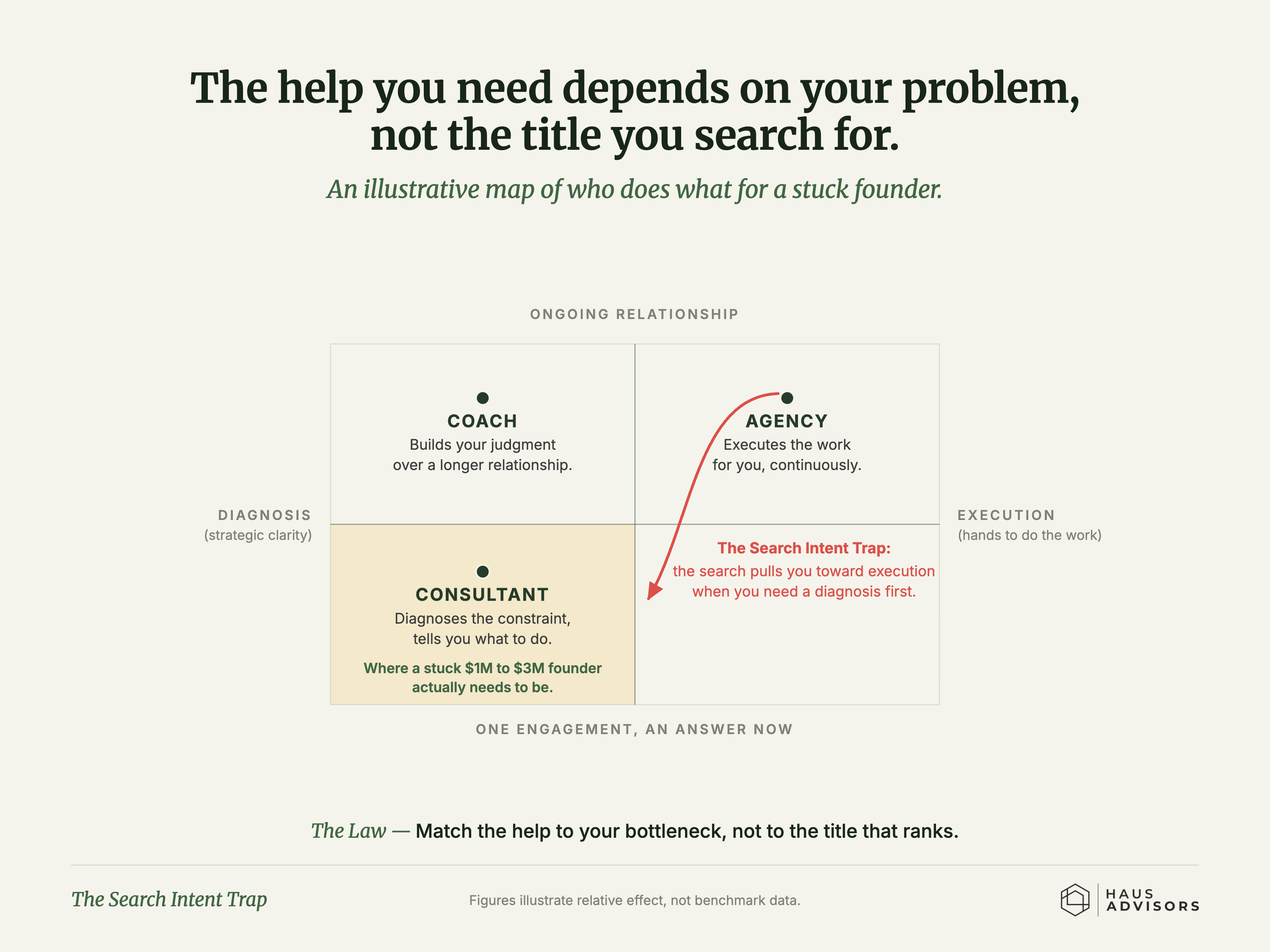
If you Google "agency growth consultant," the results are a mess. Half are marketing agencies that help companies grow. The other half are consultants who help agencies grow. Google treats these as the same query. They are completely different problems with completely different solutions.
That confusion is more than annoying, it's expensive. Because the type of help you need depends entirely on which problem you're solving, and hiring the wrong type doesn't just waste money. It sends you down a path that actively delays the right work.
I call this The Search Intent Trap, the gap between what a founder is actually struggling with and the type of help that surfaces when they go looking for answers. It's the reason founders end up with execution partners when they need strategic clarity, or coaching communities when they need diagnostic depth.
And it makes sense that you'd fall into it. When growth feels stuck, the instinct is to search for help, evaluate the options that appear, and pick the one that sounds most relevant. But if the search itself is miscategorized, even good judgment leads to a misaligned hire.
Already know you need an agency growth consultant for your $1M+ technical agency? You can skip the comparison and see how I work directly: agency growth consulting for software and dev firms.
This guide exists to fix that. By the end, you'll know whether you need a consultant, a coach, or an agency, and which specific people are worth talking to depending on where you're actually stuck.
First: Which Problem Do You Actually Have?
There are two completely different reasons people search this term, and they require different solutions.
Path 1: "I own an agency and want to grow it." You're dealing with revenue stuck between $1M–$3M, the founder still embedded in sales or delivery, margins compressing as complexity increases, and growth that feels chaotic rather than intentional. If that's you, you need a consultant or coach who specializes in agencies, someone who understands the specific dynamics of founder-led, services-based businesses.
Path 2: "I want to hire an agency to grow my business." You're focused on lead generation, SEO, paid acquisition, conversion optimization, or outsourcing execution to a reliable growth partner. If that's you, you need a growth marketing agency, not a consultant.
This article covers both paths, clearly labeled. The bulk of it focuses on Path 1, since that's where the confusion, and the cost of getting it wrong, is highest.
Consultant vs. Coach vs. Agency
These three terms get used interchangeably. They shouldn't.
A consultant diagnoses the bottleneck, designs systems and priorities, and often guides implementation. The focus is on decision clarity, helping you figure out what to do and in what order.
A coach provides advice, accountability, and perspective. Often includes group programs or masterminds. The focus is on support, mindset, and shared experience with peers facing similar challenges.
An agency executes marketing for your business, runs campaigns, produces content, manages paid channels. The focus is on doing the work.
None of these are inherently better. They're right for different moments. The pattern that consistently causes regret is hiring execution before fixing strategy, or buying advice without enough diagnostic context to know which advice applies.
At a Glance: Agency Growth Experts Compared
| Name | Type | Specialty | Best For |
|---|---|---|---|
| Haus Advisors | Consultant | Positioning & growth systems | Agency founders $1M+ who've outgrown referrals and need clarity |
| Sakas & Company | Consultant | Operations & exit planning | Owners preparing to scale delivery or plan an exit |
| Jason Swenk | Coach | Community & masterminds | Founders who want peer support and shared experience |
| Parakeeto | Consultant | Profitability & metrics | Agencies fixing utilization, pricing, and margins |
| UGURUS | Coach | Web agency growth | High-ticket web design and dev agencies |
| NoGood | Agency | Performance marketing | Brands scaling paid acquisition |
| WebFX | Agency | SEO & inbound | Mid-market brands investing in inbound growth |
Top Consultants for Scaling Your Agency
If you run an agency and growth feels messy, these are the people agency founders consistently turn to.
1. Haus Advisors
Best for: Founders whose agency can’t grow without them. They’re busy and booked, and every deal still runs through them.
Most agency growth advice starts with "you need more leads" or "you should hire sales" or "your utilization needs work." Those things matter, but only after you've answered harder questions: What kind of agency are we actually trying to build? Which services deserve focus and which are distractions? What growth lever fits our stage right now?
Haus Advisors focuses on decision clarity, not tactics. The pattern I see in the founders who hire me: the clients are happy, the work is good, and none of it grows unless the founder is in the room. The Relevance Engineering Program is six months of implementation built for exactly that. We pull what makes the agency worth hiring out of the founder’s head, build it into positioning, offers, and growth plays the team can run, and hand ownership to them. It’s built for founder-led software and services agencies with a real team.
I wrote this list and placed myself first intentionally. Not because I'm "the best," but because I serve a specific gap: founders who've already tried advice, courses, or masterminds and still feel stuck because the decisions never got clear.
See how I work: the Relevance Engineering Program
2. Sakas & Company – Karl Sakas
Best for: Agency owners thinking long-term: scale, succession, or exit.
Karl is deeply respected for a reason. He brings operational rigor without ego. His background as an agency PM shows in his work: clear processes, calm leadership guidance, and thoughtful transition planning. If you're asking "how do I make this business sustainable without me being the bottleneck?" Karl is a strong fit.
3. Jason Swenk
Best for: Founders who want energy, community, and shared experience.
Jason has built one of the largest agency-focused ecosystems through the Agency Mastery podcast, group coaching programs, and large peer networks. His strength isn't deep diagnosis — it's exposure and momentum. If you want to see how others are tackling similar challenges and feel less alone in the work, this is valuable.
4. Parakeeto – Marcel Petitpas
Best for: Agencies that are profitable on paper but struggling in reality.
Parakeeto owns the profitability conversation. They help agencies understand effective billable rates, utilization vs. capacity, and why revenue doesn't equal profit. If your agency feels "busy but broke," Marcel will show you exactly where the math is failing and how to fix it.
5. UGURUS – Brent Weaver
Best for: Web design and development agencies selling premium sites.
UGURUS is highly opinionated about niching web agencies, productized services, and selling value instead of hours. If you run a website-focused agency and want more structure around sales and delivery, this is a solid option.
Why Consultant Engagements Fail (And It's Usually Not the Consultant)
This is the part most people miss.
Founders who've had a bad experience with a consultant almost always describe the same thing: "The advice was fine. It just didn't work for us." When you dig into what actually happened, the failure rarely traces back to the quality of the advice. It traces back to a mismatch between what the founder needed and what the engagement was designed to provide.
That mismatch has three common shapes.
The survival-strategy confusion. Some consultants built their frameworks during periods of personal agency crisis, and the tactics they teach reflect that origin. What works to stabilize a struggling agency often collapses at scale. Scrappy client acquisition, aggressive discounting, saying yes to everything, these are survival moves, not growth strategies. They're not wrong in context. But they become anchors when applied to a business that's past the survival stage. Before hiring a consultant, it's worth asking: is this advice designed for growth, or recovery? The answer changes everything about whether it applies to you.
The premature execution problem. Courses and group programs are efficient. They're also generic by design, they have to be, because they serve a broad audience. Without a diagnosis first, you don't know which advice applies to your specific situation, you apply tactics out of sequence, and you blame yourself when the results don't materialize. Courses work best after clarity, not before. If you haven't yet identified your core bottleneck, a course gives you a toolkit without telling you which tool to pick up. That's not the course's fault. It's a sequencing issue.
“Courses work best after clarity, not before.”
The generalist blind spot. Agencies aren't normal businesses. They deal with sales-vs-delivery tension, founder-led growth, custom work masquerading as systems, and people-heavy margins that behave differently from product margins. A consultant who doesn't specialize in agencies will miss these dynamics, not because they lack skill, but because the pattern recognition required to diagnose agency-specific problems only comes from immersion in agency-specific contexts. If someone advises agencies the same way they advise SaaS companies or e-commerce brands, they'll identify a bottleneck that looks right on paper and miss the one that's actually holding you back.
The common thread across all three: the failure isn't in the advice. It's in the fit between the advice and the moment. Getting that fit right is the diagnostic work that has to happen before the engagement begins.
Top Growth Marketing Agencies (For Brands)
If you're not an agency owner, if you're here to hire execution for your company's growth, these are the firms to evaluate.
NoGood — Strong execution across paid channels with a modern growth mindset. Best for brands investing heavily in performance marketing.
WebFX — Large, established team with broad service coverage. Best for mid-market companies focused on SEO and inbound growth.
Common Questions About Agency Growth Consultants
What does an agency growth consultant do?
What does an agency consultant cost, and is it worth it?
What is the difference between an agency consultant and a coach?
When should you hire an agency growth consultant?
The Sequence Matters More Than the Choice
Most agencies don't stall because they lack effort or because they chose the wrong consultant. They stall because they solved the wrong problem at the wrong time.
Growth has a sequence, and each stage has a different bottleneck: positioning, offers, sales narrative, delivery capacity, pipeline consistency. They're all real. But addressing them out of order is how founders end up with a paid acquisition funnel when they need a positioning sprint, or a sales hire when they need productized services, or a mastermind community when they need a diagnostic conversation.
“Growth has a sequence, and each stage has a different bottleneck.”
The right partner isn't the one with the most impressive client list or the largest audience. It's the one equipped to diagnose which stage you're in and help you solve the problem that actually belongs to that stage, without selling you the solution they happen to offer for a different one.
If you want your agency to grow without needing you in every deal, that’s what the Relevance Engineering Program is built for. Book a call to see if it’s a fit.
The principle is simple:
There are founders who search for a consultant, and there are founders who search for the right type of help for their specific stage.
The first group evaluates options. The second group diagnoses the problem first, and the right option becomes obvious.
Not sure which problem you actually have? Take the Bottleneck Score and find your real constraint in a few minutes.
Keep reading
Browse by topic
- Positioning & Strategy
- Lead Gen & Marketing
- Sales & Biz Dev
- Pricing & Productization
- Research & Data
- Operations & Delivery
- Client Retention & Expansion
- Leadership & Culture
For founders whose agency has outgrown referrals.
One idea a week that makes a hard growth problem obvious, usually with a chart that shows you the mechanism behind it.
Built from conversations with seventy-plus agency founders on the Behind the Agency podcast.